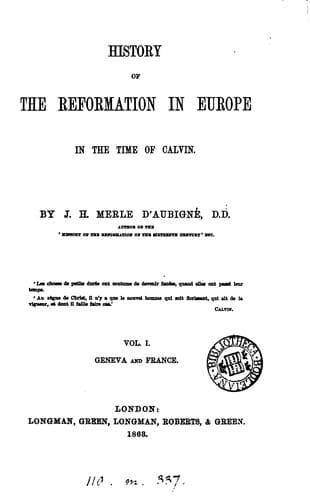
History of the Reformation in Europe in the Time of Calvin, Vol. 8 (of 8)Merle d'Aubigné, J. H. (Jean Henri)
History
History of the Reformation in Europe in the Time of Calvin, Vol. 8 (of 8)
Merle d'Aubigné, J. H. (Jean Henri)
Reformation
Norfolk was more than ever in favor, for Henry, husband of Anne of
Cleves, was at this time enamored of Norfolk's niece. He believed--and
Gardiner, doubtless, did not fail to encourage the belief--that he
must promptly take advantage of the extraordinary good-will which
the king testified to him to overthrow the adversary of Anglican
Catholicism, the powerful protector of the Bible and the Reformation.
In the judgment of this party Cromwell was a heretic and a chief of
heretics. This was the principal motive, and substantially the only
motive, of the attack made on the earl of Essex. In a letter addressed
at this time by the Council to Sir John Wallop,[334] ambassador at
the court of France, a circular letter sent also to the principal
officers and representatives of the king, the crime of which Cromwell
was accused is distinctly set forth. 'The lord privy seal,' it was
therein said, 'to whom the king's said majesty hath been so special
good and gracious lord, neither remembering his duty herein to God,
nor yet to his highness ... hath not only wrought clean contrary to
this his grace's most godly intent, secretly and indirectly advancing
the one of the extremes, and leaving the mean indifferent true and
virtuous way which his majesty sought and so entirely desired; but
also hath showed himself so fervently bent to the maintenance of that
his outrage that he hath not spared most privily, most traitorously,
to devise how to continue the same, and plainly in terms to say, as it
hath been justified to his face by good witness, that if the king and
all his realm would turn and vary from his opinions, he would fight
in the field in his own person, with his sword in his hand, against
him and all other; adding that if he lived a year or two he trusted to
bring things to that frame that it should not lie in the king's power
to resist or let it, if he would; binding his words with such oaths
and making such gesture and demonstration with his arms, that it might
well appear he had no less fixed in his heart than was uttered with his
mouth. For the which apparent and most detestable treasons, and also
for ... other enormities ... he is committed to the Tower of London,
there to remain till it shall please his majesty to have him thereupon
tried according to the order of his laws.' It was added that the king,
remembering how men wanting the knowledge of the truth would speak
diversely of the matter, desired them to declare and open the whole
truth.
Public-domain text, read in full here on John Shaqi.
Reviews
Reviews
No reviews yet
Be the first to share your thoughts on this work.
Elsewhere in the archive
Join the Discussion
Join the discussion
Sign in to leave a comment or review.
Sign InorCreate an account