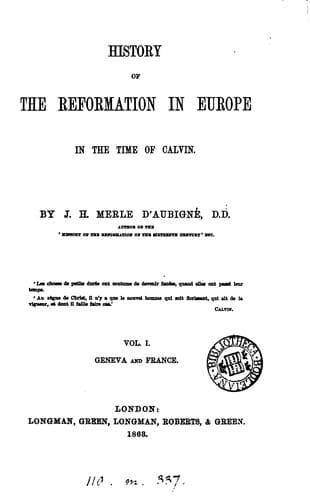
History of the Reformation in Europe in the Time of Calvin, Vol. 8 (of 8)Merle d'Aubigné, J. H. (Jean Henri)
History
History of the Reformation in Europe in the Time of Calvin, Vol. 8 (of 8)
Merle d'Aubigné, J. H. (Jean Henri)
Reformation
Meanwhile, the enemies of the prisoner were trying to find other
grounds of accusation besides that which they had first brought
forward. Indeed, it seemed to some persons a strange thing that he
who, under Henry VIII. was head of the church, vicegerent in spiritual
affairs, should be a heretic and a patron of heretics; and many found
in this charge an 'occasion of merriment.'[338] They set to work,
therefore, after the blow, to discover offences on the part of the
accused. After taking great pains, this is what they discovered and
set forth in the bill of attainder: 1. That he had set at liberty
some prisoners suspected of treason; a crime indeed in the eyes of a
gloomy despot, but in the judgment of righteous men an act of justice
and virtue. 2. That he had granted freedom of export of corn, horses,
and other articles of commerce; the crime of free trade which would
be no crime now. Not a single instance can be specified in which
Cromwell had received any present for such license. 3. That he had,
though a low-born man, given places and orders, saying only that he
was sure that the king would approve them. On this point Cromwell
might reasonably allege the multiplicity of matters entrusted to his
care, and the annoyance to which it must have subjected the king, had
he continually troubled him to decide the most trifling questions.
4. That he had given permission, both to the king's subjects and to
foreigners, to cross the sea 'without any search.' This intelligent
minister appears to have aimed at an order of things less vexatious
and more liberal than that established under Henry VIII., and in
this respect he stood ahead of his age. 5. That he had made a large
fortune, that he had lived in great state, and had not duly honored the
nobility. There were not a few of the nobles who were far from being
honorable, and this great worker had no liking for drones and idlers.
With respect to his fortune, Cromwell incurred heavy expenses for the
affairs of the realm. In many countries he kept well-paid agents, and
the money which he had in his hands was spent more in state affairs
than in satisfying his personal wishes. In all this there was evidently
more to praise than to blame. But Cromwell had enemies who went further
than his official accusers.[339] The Roman Catholics gave out that he
had aspired to the hand of the king's daughter, the princess Mary. This
would have been a strange and sympathetic union, between the _Malleus
monachorum_ and the fanatical Mary!
Public-domain text, read in full here on John Shaqi.
Reviews
Reviews
No reviews yet
Be the first to share your thoughts on this work.
Elsewhere in the archive
Join the Discussion
Join the discussion
Sign in to leave a comment or review.
Sign InorCreate an account