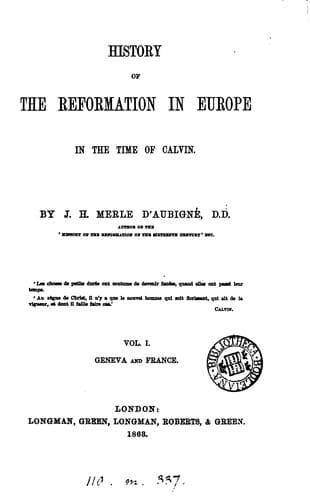
History of the Reformation in Europe in the Time of Calvin, Vol. 8 (of 8)Merle d'Aubigné, J. H. (Jean Henri)
History
History of the Reformation in Europe in the Time of Calvin, Vol. 8 (of 8)
Merle d'Aubigné, J. H. (Jean Henri)
Reformation
These groundless charges were followed by the true motives for his
disgrace. It was alleged that he had adopted heretical (that is to
say, evangelical) opinions; that he had promoted the circulation of
heretical works; that he had settled in the realm many heretical
ministers; and that he had caused men accused of heresy to be set at
liberty. That when any one went to him to make complaint of detestable
errors, he defended the heretics and severely censured the informers;
and that in March last, persons having complained to him of the new
preachers, he answered that 'their preaching was good.'[340] For
these _crimes_, the acts of a Christian, honest and beneficent man,
condemnation must be pronounced. Cromwell indeed was guilty.
[Sidenote: THE LEADER OF THE PROSECUTION.]
The conduct of the prosecution was entrusted to Richard Rich, formerly
speaker of the House of Commons, now solicitor-general and chancellor
of the court of augmentations. He had already rendered service to the
king in the trials of Bishop Fisher and Sir Thomas More; the same might
be expected of him in the trial of Cromwell. It appears that he accused
Cromwell of being connected with Throgmorton,[341] the friend and agent
of Cardinal Pole. Now the mere mention of Pole's name would put Henry
out of temper. Cromwell's alliance with this friend of the pope was the
pendant of his scheme of marriage with the lady Mary; the one was as
probable as the other. Cromwell wrote from his prison to the king on
the subject, and stoutly denied the fable. It was not introduced into
the formal pleadings; but the charge was left vaguely impending over
him, and it was reasserted that he was guilty of treason. Cromwell was
certainly not faultless. He was above all a politician, and political
interests had too much weight with him. He was the advocate of some
vexatious and unjust measures, and he acted sometimes in opposition to
his own principles. But his main fault was a too servile devotion to
the prince who pretended that he had been betrayed by him; and of this
he had given a lamentable proof in the case of Anne Boleyn.
Public-domain text, read in full here on John Shaqi.
Reviews
Reviews
No reviews yet
Be the first to share your thoughts on this work.
Elsewhere in the archive
Join the Discussion
Join the discussion
Sign in to leave a comment or review.
Sign InorCreate an account