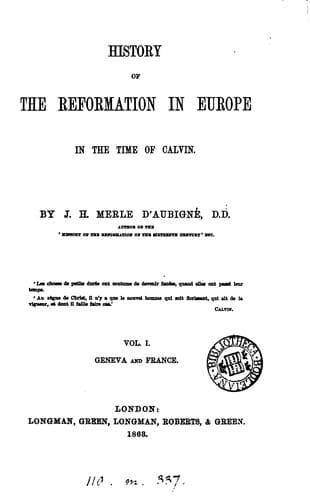
History of the Reformation in Europe in the Time of Calvin, Vol. 8 (of 8)Merle d'Aubigné, J. H. (Jean Henri)
History
History of the Reformation in Europe in the Time of Calvin, Vol. 8 (of 8)
Merle d'Aubigné, J. H. (Jean Henri)
Reformation
Thus died a man who, although he had risen from the lowliest to the
loftiest estate, never allowed himself to be seduced by pride, nor
made giddy by the pomps of the world, who continued attached to his
old acquaintances, and was eager to honor the meanest who had rendered
him any service; a man who powerfully contributed to the establishment
of Protestantism in England,[353] although his enemies, unaware of the
very different meanings of the words 'Catholicism' and 'Popery,' took
pleasure in circulating the report in Europe, after his death, that he
died a Roman Catholic; a man who for eight years governed his country,
the king, the parliament, and convocation; who had the direction of all
domestic as well as foreign affairs; who executed what he had advised,
and who, in spite of the blots which he himself lamented, was one of
the most intelligent, most active, and most influential of English
ministers.[354] It is said that the king ere long regretted him.
However this may be, he protected his son and gave him proofs of his
favor, doubtless in remembrance of his father.
Another nobleman, Walter, Lord Hungerford, was beheaded at the same
time with Cromwell, for having endeavored to ascertain, by 'conjuring,'
how long the king would live.[355]
CHAPTER VI.
DIVORCE OF ANNE OF CLEVES.
(1540.)
[Sidenote: ROME TRIUMPHANT.]
The Catholic party was triumphant. It had set aside the Protestant
queen and sacrificed the Protestant minister; and it now proceeded to
take measures of a less startling character, but which were a more
direct attack on the very work of the Reformation. It thought proper to
put to death some of those zealous men who were boldly preaching the
pure Gospel, not only for the sake of getting rid of them, but even
more for the purpose of terrifying those who were imitating them or who
were willing to do so.
Of these men, Barnes, Garret, and Jerome were the most known. They
were in prison; but Henry had hitherto scrupled about sacrificing men
who preached a doctrine opposed to the pope. The party, moreover,
united all their forces to bring about the fall of Cromwell, who had
been confined within the same walls. After his death, the death of the
preachers followed as a matter of course; it was merely the corollary;
it was a natural consequence, and needed no special demonstration; the
sentence, according to the Romish party, had only to be pronounced to
be evidently justified. On these principles the king's council and the
parliament proceeded; and two days after the execution of Cromwell,
these three evangelists, without any public hearing, without knowing
any cause of their condemnation, without receiving any communication
whatsoever,[356] were taken out of prison, July 30, 1540, to be
conducted to Smithfield, where they were to be deprived, not only of
their ministry, but of their lives.
Public-domain text, read in full here on John Shaqi.
Reviews
Reviews
No reviews yet
Be the first to share your thoughts on this work.
Elsewhere in the archive
Join the Discussion
Join the discussion
Sign in to leave a comment or review.
Sign InorCreate an account