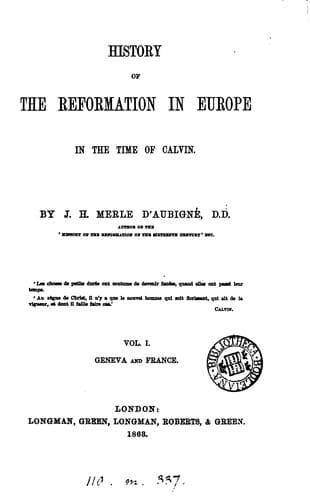
History of the Reformation in Europe in the Time of Calvin, Vol. 8 (of 8)Merle d'Aubigné, J. H. (Jean Henri)
History
History of the Reformation in Europe in the Time of Calvin, Vol. 8 (of 8)
Merle d'Aubigné, J. H. (Jean Henri)
Reformation
and then meekly gave themselves up to the executioner. They were bound
to the same stake, and breathed their last in patience and in faith.
On the same day, at the same hour, and at the same place where
the three friends of the Gospel were burnt, the three followers
of the pope, Abel, Fetherstone, and Powel were hung. A foreigner
who was present exclaimed: '_Deus bone! quomodo hic vivunt gentes?
Hic suspenduntur papistæ, illic comburuntur antipapistæ._' The
simple-minded and ignorant asked what kind of religion people should
have in England, seeing that both Romanism and Protestantism led to
death. A courtier exclaimed: 'Verily, henceforth I will be of the
king's religion, that is to say, of none at all!'[359]
[Sidenote: PROPOSED DIVORCE OF THE QUEEN.]
Cromwell and these six men were not to be the only objects of the
king's displeasure. Even before they had undergone their sentence,
the king had caused his divorce to be pronounced. In marrying Anne
of Cleves, his chief object had been to form an alliance with the
Protestants against the emperor. Now these two opponents were by this
time reconciled with each other. Henry, therefore, deeply irritated, no
longer hesitated to rid himself of the new queen. He was influenced,
moreover, by another motive. He was smitten with the charms of another
woman. However, as he dreaded the raillery, the censures, and even the
calamities which the divorce might bring upon him, he was anxious not
to appear as the originator of it, and should the accusation be made,
to be able to repel it as a foul imposture without shadow of reality.
He resolved, therefore, to adopt such a course that this strange
proceeding should seem to have been imposed upon him. This intention
he hinted to one of the lords in whom he had full confidence; and the
latter made some communications about it, on July 3, to the Privy
Council. On the 6th his majesty's ministers pointed out to the upper
house the propriety of their humbly requesting the king, in conjunction
with the lower house, that the convocation of the clergy might examine
into his marriage with Anne of Cleves, and see whether it were valid.
The lords adopted the proposal; and a commission consisting of the lord
chancellor, the archbishop of Canterbury, and the dukes of Norfolk
and Suffolk, presented it to the commons, who gave their assent to
it. Consequently the whole House of Lords and a commission of twenty
members of the lower house appeared before the king, and stated that
the matter about which they had to confer with him was of such an
important character that they must first request his permission to lay
it before them. Henry, feigning utter ignorance of what they meant,
commanded them to speak. They then said,--'We humbly pray your majesty
to allow the validity of your marriage to be investigated by the
convocation of the clergy; we attach all the more importance to this
proceeding because the question bears upon the succession to the throne
Public-domain text, read in full here on John Shaqi.
Reviews
Reviews
No reviews yet
Be the first to share your thoughts on this work.
Elsewhere in the archive
Join the Discussion
Join the discussion
Sign in to leave a comment or review.
Sign InorCreate an account