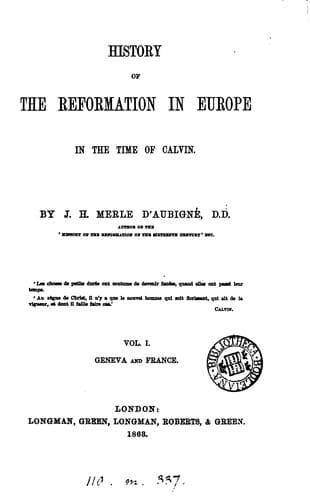
History of the Reformation in Europe in the Time of Calvin, Vol. 8 (of 8)Merle d'Aubigné, J. H. (Jean Henri)
History
History of the Reformation in Europe in the Time of Calvin, Vol. 8 (of 8)
Merle d'Aubigné, J. H. (Jean Henri)
Reformation
of your majesty.' It was well known that the king did not love Anne,
and that he was even in love with another.[360] This is a striking
instance of the degree of meanness to which Henry VIII. had reduced his
parliament; for an assembly, even if some mean souls are to be found in
it, undertakes not to be despicable, and what is noblest in it usually
comes to the surface. But if the shameful compliances of the parliament
astonish us, the audacious hypocrisy of Henry VIII. surprises us still
more. He stood up to answer as if in the presence of the Deity; and
concealing his real motives he said,--'There is nothing in the world
more dear to me than the glory of God, the good of England, and the
declaration of the truth.' All the actors in this comedy played their
parts to perfection.[361] The king immediately sent to Richmond some
of his councillors, amongst them Suffolk and Gardiner, to communicate
to the queen the demand of the parliament and to ascertain her opinion
with respect to it. After many long conferences, Anne gave her consent
to the proposal.[362]
[Sidenote: EXAMINATION OF WITNESSES.]
The next day, July 7, the matter was brought before Convocation by
Gardiner, bishop of Winchester, who was very anxious to see a Roman
Catholic queen upon the throne of England. A committee was nominated
for the purpose of examining the witnesses; and of this committee the
bishop was a member. An autograph declaration of the king was produced,
in which he dwelt strongly on the fact that he took such a dislike to
Anne as soon as he saw her that he thought instantly of breaking off
the match; that he never inwardly consented to the marriage, and that
in fact it had never been consummated.[363] Within two days all the
witnesses were heard. Henry was impatient; and the Roman party urgently
appealed to the assembly to deliver a judgment which would rid England
of a Protestant queen. Cranmer, out of fear or feebleness (he had just
seen Cromwell lose his head), went with the rest of them. In his view
the will of Henry VIII. was almost what destiny was for the ancients--
---- Des arrêts du destin l'ordre est invariable. ----
On July 9, Convocation, relying upon the two reasons given by the
king, and upon the fact that there was something ambiguous in Anne's
engagement with the son of the duke of Lorraine, decided that his
majesty 'was at liberty to contract another marriage for the good of
the realm.'[364] None of these reasons had any validity.[365] Nor
did Henry escape the condemnation and the raillery which he had so
much feared. 'It appears,' said Francis I., 'that over there they are
pleased to do with their women as with their geldings,--bring a number
of them together and make them trot, and then take the one which goes
easiest.'[366]
[Sidenote: THE DIVORCE ACCEPTED.]
Public-domain text, read in full here on John Shaqi.
Reviews
Reviews
No reviews yet
Be the first to share your thoughts on this work.
Elsewhere in the archive
Join the Discussion
Join the discussion
Sign in to leave a comment or review.
Sign InorCreate an account