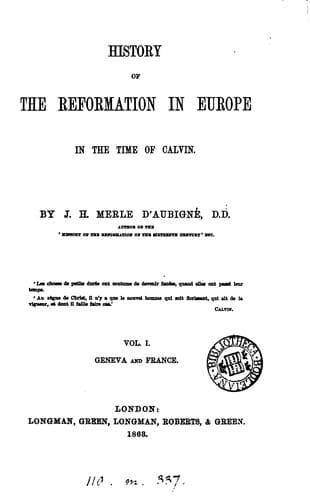
History of the Reformation in Europe in the Time of Calvin, Vol. 8 (of 8)Merle d'Aubigné, J. H. (Jean Henri)
History
History of the Reformation in Europe in the Time of Calvin, Vol. 8 (of 8)
Merle d'Aubigné, J. H. (Jean Henri)
Reformation
The new queen was distinguished from the former chiefly by the
difference in religion, with a corresponding difference in morality.
The niece of the duke of Norfolk, Gardiner's friend, was of course an
adherent of the Catholic faith; and the Catholic party hailed her as at
once the symbol and the instrument of reaction. They had had plenty of
Protestant queens, Anne Boleyn, Jane Seymour, and Anne of Cleves. Now
that they had a Catholic queen, Catholicism--many said popery--would
recover its power. Henry was so much enamored of his new spouse that,
in honor of her, he once more became a fervent Catholic. He celebrated
all the Saints' days, frequently received the holy sacrament, and
offered publicly thanksgiving to God for this happy union which he
hoped to enjoy for a long time.[374] The conversion of Henry, for the
change was nothing less, brought with it a change of policy. He now
abandoned France and the German Protestants in order to ally himself
with the empire; and we find him ere long busily engaged in a project
for the marriage of his daughter Mary to the emperor Charles V. This
project, however, came to nothing.[375] Gardiner, Norfolk, and the
other leaders of the Catholic party, rejoicing in the breeze which
bore their vessel onward, set all sails to the wind. Just after the
divorce of Anne of Cleves, and by way of a first boon to the Romish
party, the penalties for impure living imposed on priests and nuns were
mitigated.[376] In contempt of the authority of Holy Scripture as well
as of that of parliament itself, Henry got an Act passed by virtue of
which every determination concerning _faith_, worship, and ceremonies,
adopted with the sanction of the king by a commission of archbishops,
bishops, and other ecclesiastics nominated by him, _was to be received,
believed, and observed by the whole nation_, just as if parliament
had approved every one of these articles, even if this decree were
contrary to former usages and ordinances.[377] This was a proclamation
of infallibility in England for the benefit of the pope-king, under
cover of which he might found a religion to his own taste. Cranmer
had established in all cathedral churches professors entrusted with
the teaching of Hebrew and Greek, in order that students might become
well acquainted with sacred literature, and that the church might
never want ministers capable of edifying it. But the enemies of the
Reformation, who now enjoyed royal favor, fettered or abolished this
institution and other similar ones, to the great damage both of
religion and the country.[378] The Catholic ceremonies, on the other
hand, abrogated by Cranmer and Cromwell--the consecration of bread
and of water, the embers with which the priest marked the foreheads
of the faithful, the palm branches blessed on Palm Sunday, the tapers
carried at Candlemas, and other like customs--were re-established; and
penalties were imposed on those who should neglect them.[379] A new
Public-domain text, read in full here on John Shaqi.
Reviews
Reviews
No reviews yet
Be the first to share your thoughts on this work.
Elsewhere in the archive
Join the Discussion
Join the discussion
Sign in to leave a comment or review.
Sign InorCreate an account