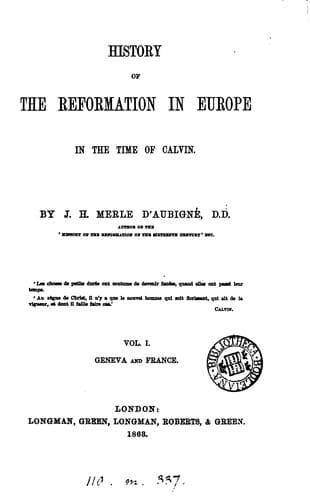
History of the Reformation in Europe in the Time of Calvin, Vol. 8 (of 8)Merle d'Aubigné, J. H. (Jean Henri)
History
History of the Reformation in Europe in the Time of Calvin, Vol. 8 (of 8)
Merle d'Aubigné, J. H. (Jean Henri)
Reformation
edition of the 'Institution of a Christian Man' explained to the people
the king's doctrine. It treated of the seven sacraments, the mass,
transubstantiation, the salutation of the Virgin, and other doctrines
of the kind to which conformity was required.[380] At length, as if
with a view to ensure the permanence of this system, Bonner was made
bishop of London; and this man, who had been the most abject flatterer
and servant of Cromwell during his life, turned about after his death
and became the persecutor of those whom Cromwell had protected.
[Sidenote: BONNER, BISHOP OF LONDON.]
At the spectacle of this reaction, so marvellous in their eyes, the
Anglican Catholics and even the papists broke out with joy, and awaited
with impatience 'the crowning of the edifice.' England, in their view,
was saved. The church was triumphant. But while there was rejoicing
on the one side, there was mourning on the other. The establishment
of superstitious practices, the prospect of the penalties contained
in the bloody statute of the Six Articles, penalties which had not
yet been enforced but were on the point of being so, spread distress
and alarm among the evangelicals. Those who did not add to their
faith manly energy shut up their convictions in their own breasts,
carefully abstained from conversation on religious subjects, and looked
with suspicion upon every stranger, fearing that he might be one of
Gardiner's spies.
Bonner was active and eager, going forward in pursuit of his object
and allowing nothing to check him. Cromwell and Cranmer, to whom he
used to make fair professions, believed that he was capable of being
of service to the Reformation, and therefore gave him promotion in
ecclesiastical offices. But no sooner had Cromwell been put in prison
than his signal deceitfulness showed itself. Grafton, who printed the
Bible under the patronage of the vicegerent, having met Bonner, to whom
Cromwell had introduced him, exclaimed, 'How grieved I am to hear that
Lord Cromwell has been sent to the Tower!' 'It would have been much
better,' replied Bonner, 'if he had been sent there long ago.' Shortly
after, Grafton was cited before the council, and was accused of having
printed, by Cromwell's order, certain suspected verses; and Bonner, for
the purpose of aggravating his criminality, did not fail to report what
the accused had said to him about the man who had been his own personal
benefactor. The chancellor, however, a friend of Grafton, succeeded
in saving the printer of the Bible. Bonner indemnified himself for
this disappointment by persecuting a great many citizens of London. He
vented his rage especially on a poor youth of fifteen, ignorant and
uncultivated, named Mekins, whom he accused of having spoken against
the Eucharist and in favor of Barnes; but the grand jury found him 'not
guilty.' Hereupon Bonner became furious. 'You are perjured,' he said to
the jury. 'The witnesses do not agree,' they replied. The one deposed
Public-domain text, read in full here on John Shaqi.
Reviews
Reviews
No reviews yet
Be the first to share your thoughts on this work.
Elsewhere in the archive
Join the Discussion
Join the discussion
Sign in to leave a comment or review.
Sign InorCreate an account