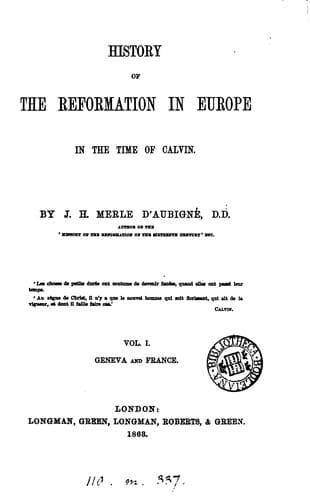
History of the Reformation in Europe in the Time of Calvin, Vol. 8 (of 8)Merle d'Aubigné, J. H. (Jean Henri)
History
History of the Reformation in Europe in the Time of Calvin, Vol. 8 (of 8)
Merle d'Aubigné, J. H. (Jean Henri)
Reformation
When they had all come into the presence of the king, he said to them
with a severe countenance: 'Ah, my lords, I thought I had had wiser
men of my council than now I find you. What discretion was this in
you, thus to make the primate of the realm, and one of you in office,
to wait at the council-chamber door amongst serving men?... You had
no such commission of me so to handle him. I was content that you
should try him as a councillor, and not as a mean subject. But now
I well perceive that things be done against him maliciously; and if
some of you might have had your minds, you would have tried him to the
uttermost. But I do you all to wit, and protest, that if a prince may
be beholding unto his subject' (and here Henry laid his hand solemnly
upon his breast), 'by the faith I owe to God, I take this man here, my
lord of Canterbury, to be of all other a most faithful subject unto us,
and one to whom we are much beholding.' The Catholic members of the
council were disconcerted, confused, and unable to make any answer. One
or two of them, however, took courage, made excuses, and assured the
king that their object in trying the primate was to clear him of the
calumnies of the world, and not to proceed against him maliciously. The
king, who was not to be imposed upon by these hypocritical assertions,
said: 'Well, well, my lords, take him and well use him, as he is worthy
to be, and make no more ado.' All the lords then went up to Cranmer,
and took him by the hand as if they had been his dearest friends. The
archbishop, who was of a conciliatory disposition, forgave them. But
the king sent to prison for a certain time some of the archbishop's
accusers; and he sent a message to Sir J. Gostwick, to the effect that
he was a wicked varlet, and that unless he made his apologies to the
metropolitan, he would make of him an example which should be a warning
to all false accusers. These facts are creditable to Henry VIII. It
was doubtless his aim to keep a certain middle course; and like many
other despots he had happy intervals. There were other evidences of
this fact. Four great Bibles appeared with his sanction in 1541; two of
them bearing the name of Tonstall, the other two that of Cranmer.[394]
Moreover, a sudden change was approaching which was to alter the whole
course of things.
Public-domain text, read in full here on John Shaqi.
Reviews
Reviews
No reviews yet
Be the first to share your thoughts on this work.
Elsewhere in the archive
Join the Discussion
Join the discussion
Sign in to leave a comment or review.
Sign InorCreate an account