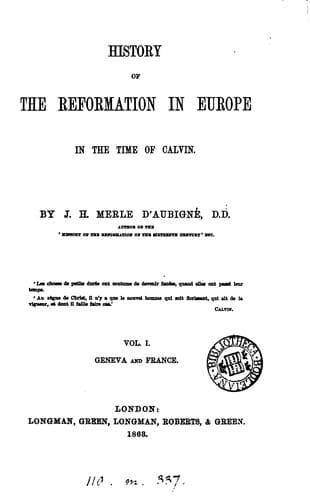
History of the Reformation in Europe in the Time of Calvin, Vol. 8 (of 8)Merle d'Aubigné, J. H. (Jean Henri)
History
History of the Reformation in Europe in the Time of Calvin, Vol. 8 (of 8)
Merle d'Aubigné, J. H. (Jean Henri)
Reformation
At the end of August, 1541, Henry went to York,[395] for the purpose of
holding an interview with his nephew, the king of Scotland, whom he was
anxious to persuade to declare himself independent of the pope. Henry
made magnificent preparations for his reception; but Cardinal Beatoun
prevented the young prince from going. This excited the bitterest
discontent in Henry's mind, and became afterwards the cause of a
breach. The queen, who accompanied him, endeavored to divert him from
his vexation; and the king, more and more pleased with his marriage,
after his return to London, made public thanksgiving on All Saints' Day
(October 24), that God had given him so amiable and excellent a wife,
and even requested the bishop of Lincoln to join in his commendations
of her. This excessive satisfaction was ere long to be interrupted.[396]
[Sidenote: DISCLOSURES ABOUT THE QUEEN.]
During the king's journey, one John Lascelles, who had a married sister
living in the county of Sussex, paid her a visit. This woman had
formerly been in the service of the old duchess of Norfolk, grandmother
to the queen, and by whom Catherine had been brought up. In the course
of conversation the brother and sister talked about this young lady,
whom the sister had known well, and who had now become wife to the
king. The brother, ambitious for his sister's advancement, said to her:
'You ought to ask the queen to place you among her attendants.' 'I
shall certainly not do so,' she answered; 'I can not think of the queen
but with sadness.' 'Why?' 'She is so frivolous in character and in
life.' 'How so?' Then the woman related that Catherine had had improper
intercourse with one of the officers of the ducal house of Norfolk,
named Francis Derham; and that she had been very familiar with another
whose name was Mannock. Lascelles perceived the importance of these
statements; and as he could not take upon himself the responsibility
of concealing them, he determined to report them to the archbishop.
The communication greatly embarrassed Cranmer. If he should keep the
matter secret and it should afterwards become known, he would be
ruined. Nor would he less certainly be ruined if he should divulge
it, and then no proof be forthcoming. But what chiefly weighed upon
his mind was the thought of the agitation which would be excited. To
think of another wife of the king executed at the Tower! To think
of his prince, his country, and perhaps also the work which was in
process of accomplishment in England, becoming the objects of ridicule
and perhaps of abhorrence! As he was unwilling to assume alone the
responsibility imposed by so grave a communication, he opened his mind
on the subject to the lord chancellor and to other members of the
privy council, to whom the king had entrusted the despatch of business
during his absence. 'They were greatly troubled and inquieted.'[397]
After having well weighed the reasons for and against, they came to
Public-domain text, read in full here on John Shaqi.
Reviews
Reviews
No reviews yet
Be the first to share your thoughts on this work.
Elsewhere in the archive
Join the Discussion
Join the discussion
Sign in to leave a comment or review.
Sign InorCreate an account