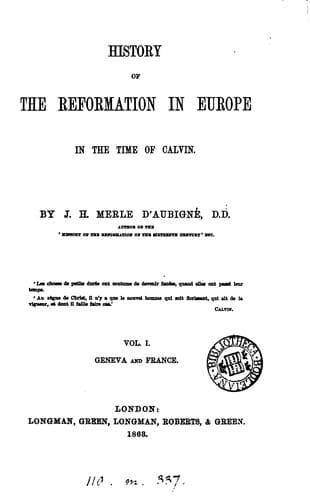
History of the Reformation in Europe in the Time of Calvin, Vol. 8 (of 8)Merle d'Aubigné, J. H. (Jean Henri)
History
History of the Reformation in Europe in the Time of Calvin, Vol. 8 (of 8)
Merle d'Aubigné, J. H. (Jean Henri)
Reformation
the conclusion that, as this matter mainly concerned the king, Cranmer
should inform him of it. This was a hard task to undertake; and the
archbishop, who was deeply affected, durst not venture to make _viva
voce_ so frightful a communication. He therefore put down in writing
the report which had been made to him, and had it laid before the king.
The latter was terribly shocked; but as he tenderly loved his wife
and had a high opinion of her virtue, he said that it was a calumny.
However, he privately assembled in his cabinet the lord privy seal, the
lord admiral, Sir Antony Brown, and Sir Thomas Wriothesley, a friend
of the duke of Norfolk, who had taken a leading part in the divorce of
Anne of Cleves, and laid the case before them, declaring at the same
time that he did not believe in it. These lords privately examined
Lascelles and his sister, who persisted in their depositions; next
Mannock and Derham, who asserted the truth of their statements; the
latter, moreover, mentioning three of the duchess of Norfolk's women
who likewise had knowledge of the facts. The members of the council
made their report to the king, who, pierced with grief, remained
silent for some time. At length he burst into tears, and commanded the
duke of Norfolk, the queen's uncle, the archbishop of Canterbury, the
high chamberlain, and the bishop of Winchester, who had promoted the
marriage, to go to Catherine and examine her. At first she denied every
thing. But when Cranmer was sent to her, on the evening of the first
inquisition, the words of the primate, his admonitions, the reports
which he made to her, which proved that her conduct was perfectly well
known, convinced her of the uselessness of her denials, and she then
made full confession, and even added some strange details. It does
not appear that the queen felt it her duty to confess her offences to
God, but she resolved at least to confess them to men. While making
her confession she was in a state of so great agitation that the
archbishop was in dread every moment of her losing her reason. He
thought, according to her confessions, that she had been seduced by the
infamous Derham, with the privity even of his own wife. The household
of the duchess-dowager of Norfolk appears to have been very disorderly.
Cranmer wrote down or caused to be written this confession, and
Catherine signed it.[398] He had scarcely left the unhappy woman, when
she fell into a state of raving delirium.
[Sidenote: THE QUEEN'S FRENZY.]
Public-domain text, read in full here on John Shaqi.
Reviews
Reviews
No reviews yet
Be the first to share your thoughts on this work.
Elsewhere in the archive
Join the Discussion
Join the discussion
Sign in to leave a comment or review.
Sign InorCreate an account