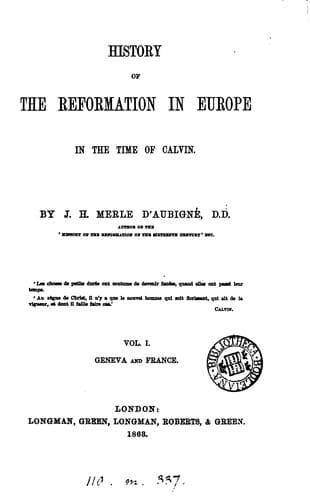
History of the Reformation in Europe in the Time of Calvin, Vol. 8 (of 8)Merle d'Aubigné, J. H. (Jean Henri)
History
History of the Reformation in Europe in the Time of Calvin, Vol. 8 (of 8)
Merle d'Aubigné, J. H. (Jean Henri)
Reformation
Now began the condemnations and the executions; and Henry VIII.
included in the trial not only those who were guilty but also the near
relatives and servants of the queen, who, though well knowing her
offences, had not reported them to the king. On the 7th, the council
determined that the duchess-dowager of Norfolk, grandmother to the
queen, her uncle, Lord William Howard, her aunts Lady Howard and Lady
Bridgewater, together with Alice Wilks, Catherine Tylney, Damport,
Walgrave, Malin Tilney, Mary Lascelles, Bulmer, Ashby, Anne Haward
and Margaret Benet were all guilty of not having revealed the crime
of high treason, and that they should be prosecuted. On the 8th the
king ordered that all these persons, Mary Lascelles excepted, should
be committed to the Tower: and this was done. Lord William Howard was
imprisoned on December 9; the duchess of Norfolk on the 10th, and Lady
Bridgewater on the 13th. All of them stoutly protested their ignorance
and their innocence.[404] On December 10, 1541, Culpeper was beheaded
at Tyburn; and the same day Derham was hung, drawn and quartered.[405]
Meanwhile, the duke of Norfolk had taken refuge at Kenninghall, about
eighty miles from London. On December 15, he wrote to the king, saying
that by reason of the offences committed by his family he found himself
in the utmost perplexity. Twice in his letter he 'prostrates himself
at the king's feet;' and he expresses 'some hope that your Highness
will not conceive any displeasure in your most gentle heart against
me; that, God knoweth, never did think thought which might be to your
discontentation.'[406] There did, however, remain something in the
'most gentle heart' of Henry VIII.
Parliament met, by the king's command, on January 16, 1542, to give
its attention to this business. Thus it was to the highest national
assembly that the king entrusted the regulation of his domestic
interests. On January 21, the chancellor introduced in the upper house
a bill in which the king was requested not to trouble himself about the
matter, considering that it might shorten his life; to declare guilty
of high treason the queen and all her accomplices; and to condemn the
queen and Lady Rochford to death. The bill passed both houses and
received the royal assent.[407]
Public-domain text, read in full here on John Shaqi.
Reviews
Reviews
No reviews yet
Be the first to share your thoughts on this work.
Elsewhere in the archive
Join the Discussion
Join the discussion
Sign in to leave a comment or review.
Sign InorCreate an account