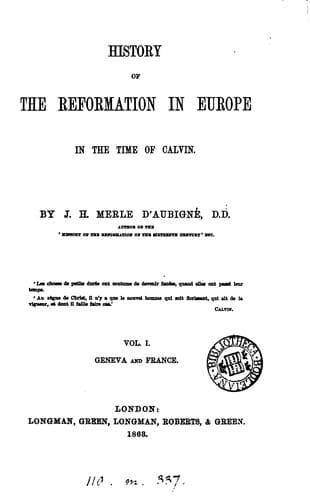
History of the Reformation in Europe in the Time of Calvin, Vol. 8 (of 8)Merle d'Aubigné, J. H. (Jean Henri)
History
History of the Reformation in Europe in the Time of Calvin, Vol. 8 (of 8)
Merle d'Aubigné, J. H. (Jean Henri)
Reformation
On February 12, the queen and Lady Rochford, her accomplice, were taken
to Tower Hill and beheaded. The queen, while she confessed the offences
which had preceded her marriage, protested to the last before God and
his holy angels that she had never violated her faith to the king. But
her previous offences gave credibility to those which were subsequent
to her marriage. With regard to Lady Rochford, the confidant of the
queen, she was universally hated. People called to mind the fact that
her calumnies had been the principal cause of the death of the innocent
Anne Boleyn and of her own husband; and nobody was sorry for her. The
king pardoned the old duchess of Norfolk and some others who had been
prosecuted for not disclosing the crime.
[Sidenote: THE QUEEN'S GUILT.]
These events did not call forth within the realm many remarks of a
painful kind for Henry VIII.; but the great example of immorality
presented by the English court lessened the esteem in which it was held
in Europe. There was no lack of similar licentiousness in France and
elsewhere; but there a veil was thrown over it, while in England it
was public talk. Opinion afterwards became severe with regard to the
king; and when his conduct to three of his former wives was remembered,
people said of the disgrace cast on him by Catherine Howard, he well
deserved it. As for the Catholic party, which had given Catherine
to Henry and had cherished the hope that by her influence it should
achieve its final triumph, it was greatly mortified, and it has been so
down to our own time. Some Catholics, referring to these offences, have
tried to lessen the abhorrence and the shame of them by saying 'that
a conspiracy was hatched to bring the queen to the scaffold.' But the
evidence produced against Catherine is so clear that they have been
obliged to alter their tone. Catholicism assuredly has had its virtuous
princesses in abundance, but it must be acknowledged that she who
became its patroness in England in 1541 did not do it much honor.[408]
Public-domain text, read in full here on John Shaqi.
Reviews
Reviews
No reviews yet
Be the first to share your thoughts on this work.
Elsewhere in the archive
Join the Discussion
Join the discussion
Sign in to leave a comment or review.
Sign InorCreate an account