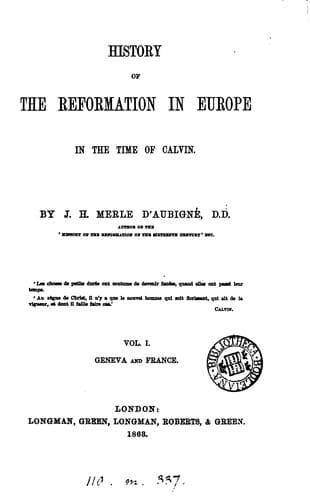
History of the Reformation in Europe in the Time of Calvin, Vol. 8 (of 8)Merle d'Aubigné, J. H. (Jean Henri)
History
History of the Reformation in Europe in the Time of Calvin, Vol. 8 (of 8)
Merle d'Aubigné, J. H. (Jean Henri)
Reformation
The elevation of Catherine Howard to the throne had been followed by an
elevation of Catholicism in England; and the fall of this unhappy woman
was followed by a depression of the party to which she belonged. This
is our reason for dwelling on her history. These last events appear to
have given offence at Rome. Pope Paul III. displayed more irritation
than ever against Henry VIII. One of the king's ambassadors at Venice
wrote to him at this time,--'The bishop of Rome is earnestly at work to
bring about a union of the emperor and the king of France for the ruin
of your majesty;' and the secret reflection that the count Ludovico de
Rangon had been in England filled the pope with fury[409] and rage.
The zeal and the caution of Cranmer in the affair of Catherine had
greatly increased the king's liking for him. Cranmer, however, was in
no haste to take advantage of this to get any bold measures passed in
favor of the Reformation. He knew that any such attempt would have had
a contrary result. But he lost no opportunity of diffusing in England
the principles of the Reformation.
Parliament met on January 16, 1542, and the Convocation of the clergy
on the 20th of the same month. On Friday, February 17, the translation
of the Holy Scriptures was on the order of the day. The suppression of
the English Bible was desired by the majority of the bishops, most of
all by Gardiner, who, since the fall of Catherine Howard, felt more
than ever the necessity of resisting reformation. As he was unable to
re-establish at once the Vulgate as a whole, he endeavored to retain
what he could of it in the translation, so that the people might not
understand what they read and might abandon it altogether. He proposed
therefore to keep in the English translation one hundred and two
Latin words 'for the sake of their native meaning and their dignity.'
Among these words were--_Ecclesia_, _pœnitentia_, _pontifex_,
_holocaustum_, _simulacrum_, _episcopus_, _confessio_, _hostia_, and
others. In addition to the design which he entertained of preventing
the people from understanding what they read, he had still another in
regard to such as might understand any part of it. If he was desirous
of retaining certain words, this was for the purpose of retaining
certain dogmas. 'Witness,' says Fuller, 'the word _Penance_, which
according to _vulgar sound_, contrary to the original sense thereof,
was a _magazine of willworship_, and brought in much _gain_ to the
_Priests_ who were desirous to _keep_ that _word_, because that
_word kept them_.'[410] Cranmer gave the king warning of the matter;
and it was agreed that the bishops should have nothing to do with
the translation of the Bible. On March 10 the archbishop informed
Convocation that it was the king's intention to have the translation
examined by the two universities. The bishops were greatly annoyed; but
Cranmer assured them that the king's determination was to be carried
out.
Public-domain text, read in full here on John Shaqi.
Reviews
Reviews
No reviews yet
Be the first to share your thoughts on this work.
Elsewhere in the archive
Join the Discussion
Join the discussion
Sign in to leave a comment or review.
Sign InorCreate an account