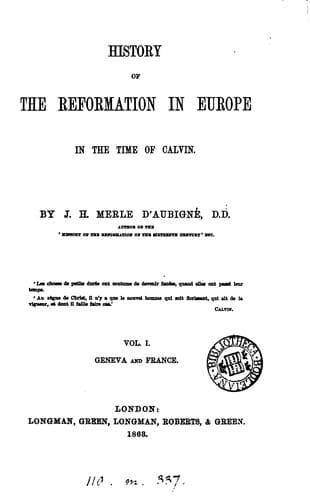
History of the Reformation in Europe in the Time of Calvin, Vol. 8 (of 8)Merle d'Aubigné, J. H. (Jean Henri)
History
History of the Reformation in Europe in the Time of Calvin, Vol. 8 (of 8)
Merle d'Aubigné, J. H. (Jean Henri)
Reformation
While laymen thus joined knowledge with faith, and business with
teaching, Cranmer was slowly pursuing his task. When parliament met,
January 22, 1543, the archbishop introduced 'a Bill for the advancement
of true religion.' This Act at once prohibited and enjoined the reading
of the Bible. Was this intentional or accidental? We are disposed to
think it accidental. There were two currents of opinion in England, and
both of them reappeared in the laws. Only it is to be noted that the
better current was the stronger; it was the good cause which seemed
ultimately to gain the ascendency on this occasion. It was ordered
that the Bibles bearing Tyndale's name should be suppressed; but the
printers still issued his translation with hardly any alteration,
shielding it under the names of Matthew, Taverner, Cranmer, and even
Tonstall and Heath.[418] It was therefore read everywhere. The Act
forbade that any one should read the Bible to others, either in any
church or elsewhere, without the sanction of the king or of some
bishop. But at the same time the chancellor of England, officers of
the army, the king's judges, the magistrates of any town or borough,
and the Speaker of the House of Commons, who were accustomed to take a
passage of Scripture as the text of their discourses, were empowered
to read it. Further, every person of noble rank, male or female, being
head of a family, was permitted to read the Bible or to cause it to
be read by one of their domestics, in their own house, their garden
or orchard, to their own family. Likewise, every trader or other
person being head of a household was allowed to read it in private;
but apprentices, work-people, &c., were to abstain. This enactment,
thus interdicting the Bible to the common people, was both impious and
absurd; impious in its prohibition, but also absurd, because reading
in the family was recommended, and this might be done even by the
domestics. The knowledge of the Scriptures might thus reach those to
whom they were proscribed.[419]
[Sidenote: CRANMER'S ENDEAVORS.]
At the same time, on the demand of Cranmer, the Act of Six Articles was
somewhat modified. Those who had infringed its clauses were no longer
to be punished with death, if they were laymen; and priests were to
incur this penalty only after the third offence. This was certainly no
great gain, but the primate obtained what he could.
Public-domain text, read in full here on John Shaqi.
Reviews
Reviews
No reviews yet
Be the first to share your thoughts on this work.
Elsewhere in the archive
Join the Discussion
Join the discussion
Sign in to leave a comment or review.
Sign InorCreate an account