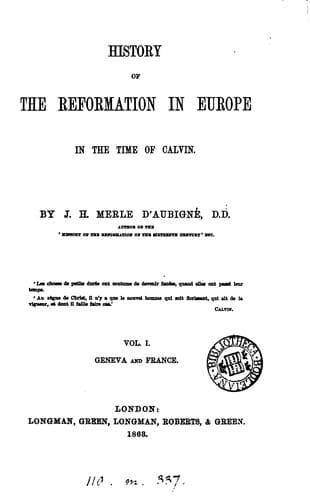
History of the Reformation in Europe in the Time of Calvin, Vol. 8 (of 8)Merle d'Aubigné, J. H. (Jean Henri)
History
History of the Reformation in Europe in the Time of Calvin, Vol. 8 (of 8)
Merle d'Aubigné, J. H. (Jean Henri)
Reformation
Henry furnished them with the wished-for opportunity. Annoyed at having
been humiliated in the presence of the two lords, he said to them in an
ironical tone: 'A good hearing it is when women become such clerks; and
a thing much to my comfort, to come in mine old days to be taught by my
wife.' The bishop adroitly availed himself of this opening, and put
forth all his powers and all his malice to increase the anger of the
king. He urged that it was lamentable that the queen 'should so much
forget herself as to take upon her to stand in any argument with his
Majesty;' he praised the king to his face 'for his rare virtues, and
especially for his learned judgment in matters of religion, above not
only princes of that and other ages, but also above doctors professed
in theology.' He said 'that it was an unseemly thing for any of his
majesty's subjects to reason and argue with him so malapertly,' and
that it was 'grievous to him (Gardiner) for his part, and other of his
majesty's counsellors and servants to hear the same.' He added 'that
they all by proof knew his wisdom to be such, that it was not needful
for any to put him in mind of any such matters; inferring, moreover,
how dangerous and perilous a matter it is ... for a prince to suffer
such insolent words at his subjects' hands, who, as they take boldness
to contrary their sovereign in words, so want they no will, but only
power and strength, to overthwart him in deeds.[453] Besides this, that
the religion by the queen so stiffly maintained did not only disallow
and dissolve the policy and politic government of princes, but also
taught the people that all things ought to be in common.'[454] The
bishop went on to assert that 'whosoever (saving the reverence due to
her for his majesty's sake) should defend the principles maintained
by the queen, deserved death.' He did not, however, dare, he said,
to speak of the queen, unless he were sure that his majesty would be
his buckler. But with his majesty's consent his faithful counsellors
would soon tear off the hypocritical mask of heresy and would disclose
treasons so horrible that his majesty would no longer cherish a serpent
in his own bosom.
[Sidenote: THE KING'S DISTRUST.]
The lord chancellor spoke in his turn; and the two conspirators did
every thing they could to stir up the anger of the king against the
queen. They filled his head with a thousand tales, both about herself
and about some of her lady-attendants; they told him that they had
been favorable to Anne Askew; that they had in their possession
heretical books; and that they were guilty of treason as well as of
heresy. Suspicion and distrust, to which the king's disposition was too
naturally inclined, took possession of him, and he required his two
councillors to ascertain whether any articles of law could be brought
forward against the queen, even at the risk of her life.[455] They
quitted the king's presence, promising to make very good use of the
commission entrusted to them.
Public-domain text, read in full here on John Shaqi.
Reviews
Reviews
No reviews yet
Be the first to share your thoughts on this work.
Elsewhere in the archive
Join the Discussion
Join the discussion
Sign in to leave a comment or review.
Sign InorCreate an account