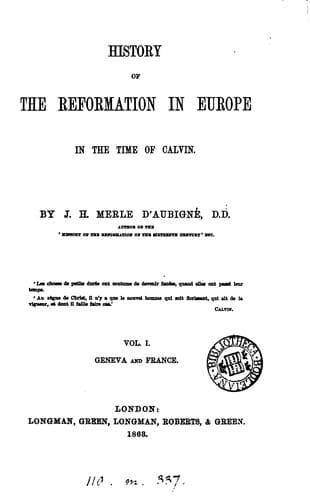
History of the Reformation in Europe in the Time of Calvin, Vol. 8 (of 8)Merle d'Aubigné, J. H. (Jean Henri)
History
History of the Reformation in Europe in the Time of Calvin, Vol. 8 (of 8)
Merle d'Aubigné, J. H. (Jean Henri)
Reformation
The bishop and the chancellor set to work immediately. They resorted to
means of every kind--tricks, intrigues, secret correspondence--for the
purpose of making out an appearance of guilt on the part of the queen.
By bribing some of her domestics they were enabled to get a catalogue
of the books which she had in her cabinet. Taking counsel with some of
their accomplices, it occurred to them that if they began by attacking
the queen, this step would excite almost universal reprobation. They
determined, therefore, to prepare men's minds by making a beginning
with the ladies who enjoyed her confidence, and particularly with those
of her own kindred--Lady Herbert, afterwards countess of Pembroke,
the queen's sister, and first lady of her court; Lady Lane, her
cousin-german; and Lady Tyrwit, who by her virtues had gained her
entire confidence. Their plan was to examine these three ladies on the
Six Articles; to institute a rigorous search in their houses with a
view to find some ground of accusation against Queen Catherine; and, in
case they should succeed, to arrest the queen herself and carry her
off _by night, in a bark_, to the Tower. The further they proceeded
with their work of darkness, the more they encouraged and cheered each
other on; they considered themselves quite strong enough to strike at
once the great blow, and they resolved to make the first attack on the
queen. They therefore drew up against her a bill of indictment, which
purported especially that she had contravened the Six Articles, had
violated the royal proclamation by reading prohibited books, and, in
short, had openly maintained heretical doctrine. Nothing was wanting
but to get the king's signature to the bill; for if, without the
sanction of this signature, they should cast suspicions on the queen,
they would expose themselves to a charge of high treason.[456]
Henry VIII. was now at Whitehall; and in consequence of the state of
his health he very seldom left his private apartments. But few of his
councillors, and these only by special order, were allowed to see him.
Gardiner and Wriothesley alone came to the palace more frequently
than usual to confer with him on the mission which he had entrusted
to them. Taking with them their hateful indictment, they went to the
palace, were admitted to the king's presence, and after a suitable
introduction they laid before him the fatal document, requesting him
to sign it. Henry read it, and took careful note of its contents;
then asked for writing materials, and notwithstanding his feebleness
he signed it. This was a great victory for the bishop, the chancellor
and the Catholic party; and it was a great defeat for the Reformation,
apparently the signal for its ruin. Nothing was now wanting but a writ
of arrest, and the chancellor of England would send the queen to the
Tower. Once there, her situation would be hopeless.
Public-domain text, read in full here on John Shaqi.
Reviews
Reviews
No reviews yet
Be the first to share your thoughts on this work.
Elsewhere in the archive
Join the Discussion
Join the discussion
Sign in to leave a comment or review.
Sign InorCreate an account