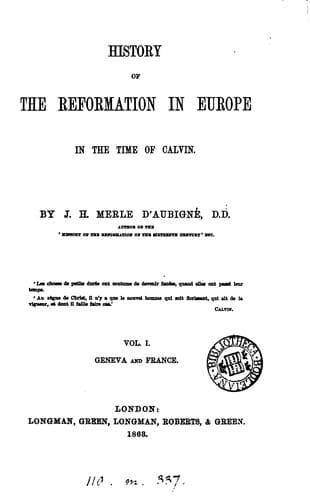
History of the Reformation in Europe in the Time of Calvin, Vol. 8 (of 8)Merle d'Aubigné, J. H. (Jean Henri)
History
History of the Reformation in Europe in the Time of Calvin, Vol. 8 (of 8)
Merle d'Aubigné, J. H. (Jean Henri)
Reformation
So cleverly had the plot been managed, that during the whole time the
queen had neither known nor suspected any thing; she paid her usual
visits to the king, and had gradually allowed herself to speak to
him on religion as she used to do. The king permitted this without
gainsaying her; he did not choose to enter into explanations with
her. He was, however, ill at ease. The burden was oppressive; and one
evening, just after the queen left him, he opened his mind to one of
his physicians, in whom he placed full confidence, and said: 'I do
not like the queen's religion, and I do not intend to be much longer
worried by the discourses of this _doctoress_.' He likewise revealed
to the physician the project formed by some of his councillors, but
forbade him, upon pain of death, to say a word about it to any living
soul. Apparently forgetting the wives whom he had already sacrificed,
Henry was thus coolly preparing, at the very time when he was himself
about to go down to the grave, to add another victim to the hecatomb.
[Sidenote: BILL OF INDICTMENT.]
The queen, although encompassed with deadly enemies who were contriving
her ruin, was in a state of perfect calmness, when suddenly there
burst upon her one of those heavy squalls which in the twinkling of an
eye dash the most powerful vessels against the rocks. The chancellor,
contented with his triumph, but at the same time agitated, snatched up
the paper which, now bearing the king's signature, ensured the death of
the queen. Vehement passions sometimes distract men and produce absence
of mind. In this case it appears that Wriothesley carelessly thrust
the paper into his bosom, and dropped it while crossing one of the
apartments of the palace.[457] A pious woman of the court, happening
to pass that way shortly afterwards, saw the paper and picked it up.
Perceiving at the first glance its importance she took it immediately
to the queen. Catherine opened it, read the articles with fear and
trembling, and as soon as she saw Henry's signature, was struck
as by a thunderbolt, and fell into a frightful agony. Her features
were completely changed: she uttered loud cries, and seemed to be in
her death-struggle. She too, then, was to lay down her life on the
scaffold. All her attentions, all her devotion to the king, had availed
nothing; she must undergo the common lot of the wives of Henry VIII.
She bewailed her fate, and struggled against it. At other times she had
glimpses of her own faults and uttered reproaches against herself, and
then her distress and her lamentations increased. Those of her ladies
who were present could hardly bear the sight of so woful a state; and,
trembling themselves, and supposing that the queen was about to be put
to death, they were unable to offer her consolation. The remembrance of
this harrowing scene was never effaced from their minds.[458]
Public-domain text, read in full here on John Shaqi.
Reviews
Reviews
No reviews yet
Be the first to share your thoughts on this work.
Elsewhere in the archive
Join the Discussion
Join the discussion
Sign in to leave a comment or review.
Sign InorCreate an account