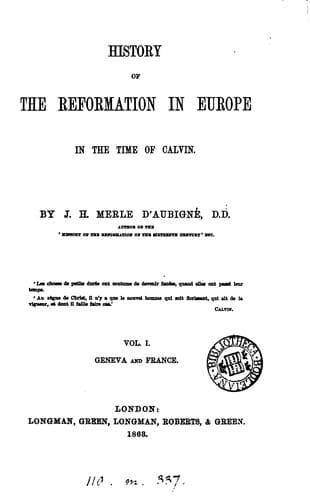
History of the Reformation in Europe in the Time of Calvin, Vol. 8 (of 8)Merle d'Aubigné, J. H. (Jean Henri)
History
History of the Reformation in Europe in the Time of Calvin, Vol. 8 (of 8)
Merle d'Aubigné, J. H. (Jean Henri)
Reformation
In addition to the suffering caused by his disease, the king was
oppressed by anxiety at the thought of the ambition and rebellion which
might snatch the crown from his son and create disturbances in the
kingdom after his death. The court was at this time divided into two
parties. One of these was headed by the duke of Norfolk, who, owing
to his position as chief of the ancient family of the Howards, allied
even to the blood royal, was next to the king the most influential
man in England. He had long been lord treasurer, and had rendered
signal services to the crown. Opposed to this party was that of the
Seymours, who had not hitherto played any great part, but who now, as
uncles to the young prince, found themselves continually advancing in
esteem and authority. Norfolk was the chief of the Catholic party;
and a great number of evangelical Christians had been burnt while
he was at the head of the government. His son, the earl of Surrey,
was likewise attached to the doctrines of the Middle Ages, and was
even suspected of having associated in Italy with Cardinal Pole. The
Seymours, on the other hand, had always shown themselves friendly to
the Reformation; and while Norfolk supported Gardiner, they supported
Cranmer. It appeared inevitable that, after the king's death, war would
break out between these chiefs, and what would happen then? The more
Henry's strength declined, the more numerous became the partisans of
the Seymours. The sun was rising for the uncles of the young prince,
and was setting for Norfolk. The duke, perceiving this, made advances
to the Seymours. He would have liked his son to marry the daughter of
the earl of Hertford, and his daughter, widow of the duke of Richmond,
the natural son of the king, to marry Sir Thomas Seymour. But neither
Surrey nor the duchess were disposed to the match. There was therefore
nothing to expect but a vigorous conflict; and the king chose that
the victory of the one party and the defeat of the other should be
determined in his lifetime and through his intervention. To which
of the two parties would the king give the preference? He had always
leaned for support upon Norfolk, and the religious views of this old
servant were his own. Would he separate from him at this critical
moment? After having from the first resisted the Reformation, would he,
on the brink of the grave, give it the victory? The past had belonged
to Roman Catholicism; should the future belong to the Gospel? Should
his death belie his whole life? The infamous conspiracy formed against
the queen by the Catholic party would not have been enough to induce
the king to adopt so strange a resolution. A circumstance of another
kind occurred to determine his course.
Public-domain text, read in full here on John Shaqi.
Reviews
Reviews
No reviews yet
Be the first to share your thoughts on this work.
Elsewhere in the archive
Join the Discussion
Join the discussion
Sign in to leave a comment or review.
Sign InorCreate an account