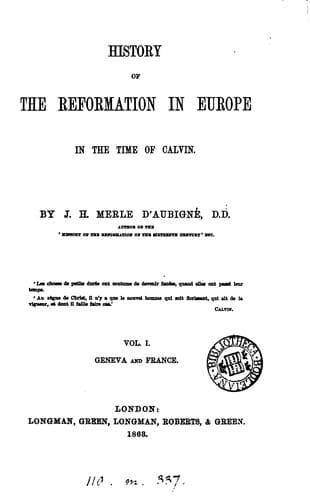
History of the Reformation in Europe in the Time of Calvin, Vol. 8 (of 8)Merle d'Aubigné, J. H. (Jean Henri)
History
History of the Reformation in Europe in the Time of Calvin, Vol. 8 (of 8)
Merle d'Aubigné, J. H. (Jean Henri)
Reformation
At the beginning of December, 1546, Sir Richard Southwell, who was
afterwards a member of the privy council under Queen Mary, gave the
king a warning that the powerful family of the Howards would expose
his son to great danger. Before the birth of Edward, Norfolk had been
designated as one of the claimants of the crown. His eldest son was a
young man of great intelligence, high spirit and indomitable courage,
and excelled in military exercises. To these qualifications he added
the polish of a courtier, fine taste and an ardent love for the fine
arts; his contemporaries were charmed by his poems; and he was looked
upon as the flower of the English nobility. These brilliant endowments
formed a snare for him. 'His head,' people said to the king, 'is filled
with ambitious projects.' He had borne the arms of Edward the Confessor
in the first quarter, which the king alone had the right to do; if,
it was added, he has refused the hand of the daughter of the earl of
Hertford, it is because he aspires to that of the princess Mary; and
if he should marry her after the death of the king, prince Edward will
lose the crown.
The king ordered his chancellor to investigate the charges against
the duke of Norfolk and his son, the earl of Surrey; and Wriothesley
ere long presented to him a paper, in the form of questions, in his
(Wriothesley's) own handwriting. The king read it attentively, pen in
hand, hardly able to repress his anger, and underlined with a trembling
hand those passages which appeared to him the most important. The
following sentences are specimens of what he read:--
'If a man coming _of the collateral line to the heir of the crown_, who
ought not to bear the arms of England but on the second quarter ... _do
presume_ ... to bear them in the first quarter, ... _how this man's
intent is to be judged_....
'If a man compassing _with himself to govern the realm do actually
go about to rule the king_, and should for that purpose advise his
daughter or sister to become his harlot, thinking thereby to bring it
to pass ... what this importeth.
'If a man say these words,--If the king die, who should have the rule
of the prince but my father or I? what it importeth.'[468]
[Sidenote: THE ARREST.]
Public-domain text, read in full here on John Shaqi.
Reviews
Reviews
No reviews yet
Be the first to share your thoughts on this work.
Elsewhere in the archive
Join the Discussion
Join the discussion
Sign in to leave a comment or review.
Sign InorCreate an account