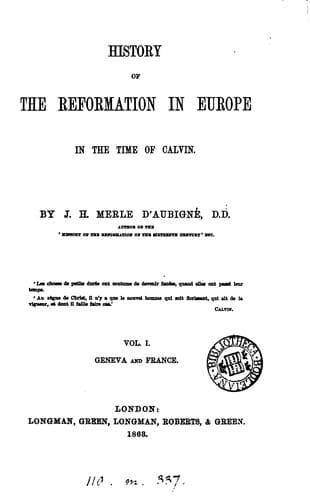
History of the Reformation in Europe in the Time of Calvin, Vol. 8 (of 8)Merle d'Aubigné, J. H. (Jean Henri)
History
History of the Reformation in Europe in the Time of Calvin, Vol. 8 (of 8)
Merle d'Aubigné, J. H. (Jean Henri)
Reformation
The charges brought against Norfolk and Surrey were mere pretexts. No
notice having been taken of the letter just cited, the old man, who was
anxious by any means to save his life, determined to humble himself
still further. On January 12, nine days before the death of Surrey,
in the hope of satisfying the king, he made, in the presence of the
members of the privy council, the following confession:--'I, Thomas,
duke of Norfolk, do confess and acknowledge myself... to have offended
the king's most excellent majesty, in the disclosing... of his privy
and secret counsel... to the great peril of his Highness.... That I
have concealed high treason, in keeping secret the false and traitorous
act... committed by my son... against the king's majesty... in the
putting and using the arms of Edward the Confessor,... in his scutcheon
or arms.... Also, that to the peril, slander, and disinherison of the
king's majesty and his noble son, Prince Edward, I have... borne in
the first quarter of my arms... the arms of England.... Although I be
not worthy to have... the king's clemency and mercy to be extended to
me,... yet with a most sorrowful and repentant heart do beseech his
Highness to have mercy, pity, and compassion on me.'[474]
All was fruitless; Norfolk must die like the best servants and friends
of the king, like Fisher, Sir Thomas More, and Cromwell. But the duke
could not be condemned with so little formality as Surrey. The king,
therefore, assembled the parliament; a bill was presented to the House
of Lords, and the three readings were hurried through on January 18,
19, 20. The bill, sent down to the Commons, was passed by them, and was
sent back on the 24th. Although it was customary to reserve the final
step to the close of the session, the king, who was in haste, gave his
assent on Thursday the 27th, and the execution of Norfolk was fixed for
the morning of the next day. All the preparations for this last act
were made during the night; and but a few moments were to intervene
before this once powerful man was to be led to the scaffold.
Two victims were now awaiting the remorseless scythe of destiny. Death
was approaching at the same time the threshold of the palace and that
of the prison. Two men who had filled the world with their renown, who
during their lifetime had been closely united, and were the foremost
personages of the realm, were about to pass the inexorable gates and to
be bound with those bonds which God alone can burst. The only question
was which of the two would be the first to receive the final stroke.
The general expectation was, no doubt, that Norfolk would be the first,
for the executioner was already sharpening the axe which was to smite
him.
[Sidenote: LAST HOURS OF HENRY VIII.]
Public-domain text, read in full here on John Shaqi.
Reviews
Reviews
No reviews yet
Be the first to share your thoughts on this work.
Elsewhere in the archive
Join the Discussion
Join the discussion
Sign in to leave a comment or review.
Sign InorCreate an account