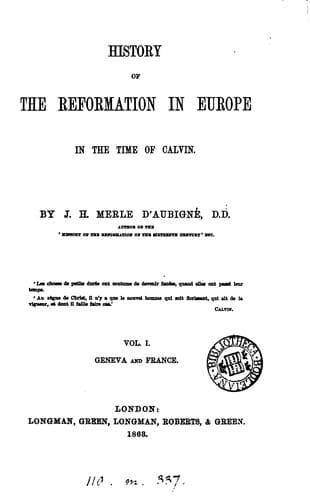
History of the Reformation in Europe in the Time of Calvin, Vol. 8 (of 8)Merle d'Aubigné, J. H. (Jean Henri)
History
History of the Reformation in Europe in the Time of Calvin, Vol. 8 (of 8)
Merle d'Aubigné, J. H. (Jean Henri)
Reformation
While the duke, still full of vigorous life, was awaiting in his
dungeon the cruel death which he had striven so much to avert, Henry
VIII. was prostrate on his sick bed at Whitehall. Although every thing
showed that his last hour was at hand, his physicians did not venture
to inform him of it; as it was against the law for any one to speak
of the death of the king. One might have said that he was determined
to have himself declared immortal by act of parliament. At length,
however, Sir Antony Denny, who hardly ever left him, took courage and,
approaching the bedside of the dying monarch, cautiously told him that
all hope, humanly speaking, was lost, and entreated him to prepare for
death. The king, conscious of his failing strength, accused himself of
various offences, but added that the grace of God could forgive him all
his sins. It has been asserted that he did really repent of his errors.
'Several English gentlemen,' says Thevet, 'assured me that he was truly
repentant, and among other things, on account of the injury and crime
committed against the said queen (Anne Boleyn).'[475] This is not
certain; but we know that Denny, glad to hear him speak of his sins,
asked him whether he did not wish to see some ecclesiastic. 'If I see
any one,' said Henry, 'it must be Archbishop Cranmer.' 'Shall I send
for him?' said Denny. The king replied: 'I will first take a little
sleep, and then, as I feel myself, I will advise upon the matter.' An
hour or two later the king awoke, and finding that he was now weaker,
he asked for Cranmer. The archbishop was at Croydon; and when he
arrived the dying man was unable to speak, and was almost unconscious.
However, when he saw the primate, he stretched out his hand, but could
not utter a word. The archbishop exhorted him to put all his trust in
Christ and to implore his mercy. 'Give some token with your eyes or
hand,' he said, 'that you trust in the Lord.' The king wrung Cranmer's
hand as hard as he could, and soon after breathed his last. He died at
two o'clock in the morning, Friday, January 28, 1547.[476]
By Henry's death Norfolk's life was saved. The new government declined
to begin the new reign by putting to death the foremost peer of
England. Norfolk lived for eight years longer. He spent, indeed, the
greater part of it in prison; but for more than a year he was at
liberty, and died at last at Kenninghall.
Public-domain text, read in full here on John Shaqi.
Reviews
Reviews
No reviews yet
Be the first to share your thoughts on this work.
Elsewhere in the archive
Join the Discussion
Join the discussion
Sign in to leave a comment or review.
Sign InorCreate an account