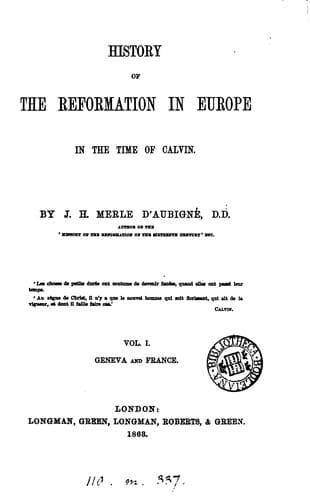
History of the Reformation in Europe in the Time of Calvin, Vol. 8 (of 8)Merle d'Aubigné, J. H. (Jean Henri)
History
History of the Reformation in Europe in the Time of Calvin, Vol. 8 (of 8)
Merle d'Aubigné, J. H. (Jean Henri)
Reformation
Henry had brought into the world with him remarkable capacities, and
these had been improved by education. He has been praised for his
application to the business of the State, for his wonderful cleverness,
his rare eloquence, his high courage. He has been looked upon as a
Mæcenas, and pronounced a great prince. His abilities certainly give
him a place above the average of kings. He regularly attended the
council, corresponded with his ambassadors, and took much pains. In
politics he had some clear views; he caused the Bible to be printed;
but the moral sentiment is shocked when he is held up as a model.
The two most conspicuous features of his character were pride and
sensuality; and by these vices he was driven to most blameworthy
actions, and even to crimes. Pride led him to make himself head of
the church, to claim the right to regulate the faith of his subjects,
and to punish cruelly those who had the audacity to hold any other
opinions on matters of religion than his own. The Reformation, of
which he is assumed to be the author, was hardly a pseudo-reform; we
might rather see in it another species of _de_formation. Claiming
autocracy in matters of faith, he naturally claimed the same in matters
of state. All the duties of his subjects were summed up by him in the
one word _obedience_; and those who refused to bow the head to his
despotic rule were almost sure to lose it. He was covetous, prodigal,
capricious, suspicious; not only was he fickle in his friendships,
but on many occasions he did not hesitate to take his victims from
amongst his best friends. His treatment of his wives, and especially
of Anne Boleyn, condemns him as a man; his bloody persecutions of the
evangelicals condemn him as a Christian; the scandalous servility which
he endeavored, and not unsuccessfully, to engraft in the nobles, the
bishops, the house of commons and the people, condemn him as a king.
BOOK XVI.
GERMANY TO THE DEATH OF LUTHER.
CHAPTER I.
PROGRESS OF THE REFORMATION IN GERMANY.
(1520--1536.)
Public-domain text, read in full here on John Shaqi.
Reviews
Reviews
No reviews yet
Be the first to share your thoughts on this work.
Elsewhere in the archive
Join the Discussion
Join the discussion
Sign in to leave a comment or review.
Sign InorCreate an account