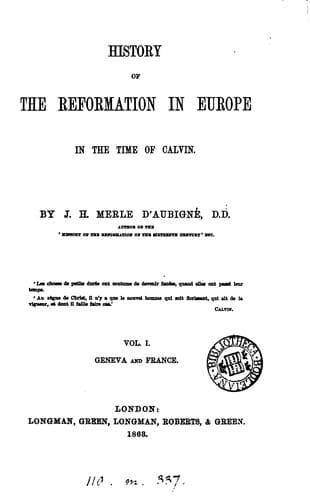
History of the Reformation in Europe in the Time of Calvin, Vol. 8 (of 8)Merle d'Aubigné, J. H. (Jean Henri)
History
History of the Reformation in Europe in the Time of Calvin, Vol. 8 (of 8)
Merle d'Aubigné, J. H. (Jean Henri)
Reformation
Henry died at the age of fifty-six years. It is no easy task to sketch
the character of a prince whose principal feature was inconsistency.
Moreover, as Lord Herbert of Cherbury said, his history is his best
portrait. The epoch in which he lived was that of a resurrection of the
human mind. Literature and the arts, political liberty, and evangelical
faith were now coming forth from the tomb and returning to life. The
human mind, since the outburst of bright light which then illumined it,
has sometimes given itself up, it must be confessed, to strange errors;
but it has never again fallen into its old sleep. There were some
kings, such as Henry VIII. and Francis I., who took an interest in the
revival of letters; but the greater number were alarmed at the revival
of freedom and of faith, and instead of welcoming tried to stifle
them. Some authors, and particularly Fox, have asserted that if death
had not prevented him, Henry VIII. would have so securely established
the Reformation as not to leave a single mass in the kingdom. This is
nothing more than a hypothesis, and it appears to us a very doubtful
one. The king had made his will two years before his death, when he was
setting out for the war with France. In it, his chief object was to
regulate the order of succession and the composition of the council of
regency; but at the same time it contains positive signs of scholastic
Catholicism. In this document the king says: 'We do instantly desire
and require the blessed Virgin Mary His mother, with all the holy
company of heaven, continually to pray for us and with us while we live
in this world, and in time of passing out of the same.'
[Sidenote: HIS WILL.]
Moreover, he ordained that the dean and canons of the chapel royal,
Windsor, and their successors forever, should have two priests to say
masses at the altar.[477] The will was rewritten on December 13, 1546;
and the members of the Privy Council signed it as witnesses. But the
only change which the king introduced was the omission of Gardiner's
name among the members of the council of regency. The passages
respecting the Virgin and masses for his soul were retained.
Public-domain text, read in full here on John Shaqi.
Reviews
Reviews
No reviews yet
Be the first to share your thoughts on this work.
Elsewhere in the archive
Join the Discussion
Join the discussion
Sign in to leave a comment or review.
Sign InorCreate an account