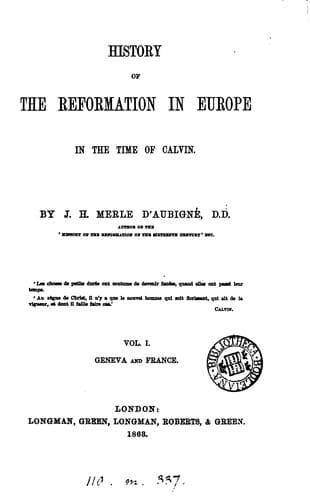
History of the Reformation in Europe in the Time of Calvin, Vol. 8 (of 8)Merle d'Aubigné, J. H. (Jean Henri)
History
History of the Reformation in Europe in the Time of Calvin, Vol. 8 (of 8)
Merle d'Aubigné, J. H. (Jean Henri)
Reformation
There is, however, one point on which the papacy imagines that it may
claim a triumph, that is, unity; and yet on this very point it fails.
Roman Catholics know no other unity than that of the disciples of human
science,--of mathematics, for example. Just as all the pupils in a
school are agreed about the theorems of Euclid, the papacy requires
that all the faithful, who in her opinion ought to be nothing but
pupils, should be agreed about the dogmas which she establishes in
her councils or in her Vatican retreats. Unity, she says, is the
assertion of the same decrees. The Gospel is not satisfied with this
scholastic uniformity; it demands a union more intimate, more profound,
more vital--at once more human and more divine. It requires that all
Christians should 'be likeminded, having the same love, being of one
accord, of one mind;' a true 'fellowship of the Spirit;'[478] and this
union it founds upon Christ, on the truth--'that there is no salvation
in any other,' and on the fact that all those who are saved have in Him
the same righteousness, the same redemption.[479] Christ reveals the
divine nature of Christian unity,--'I in them,' he said, 'that they may
be one as we are one.'[480] This is assuredly something different from
the mechanical and scholastic unity of which the Roman doctors make
their boast. The unity of the Gospel is not a crystallization like the
unity of Rome, it is a movement full of life.
[Sidenote: EFFECTS OF THE REFORMATION.]
All kinds of human progress date from the Reformation. It produced
religious progress by substituting for the forms and the rites which
are the essence of Romish religion, a life of communion with God. It
produced moral progress by introducing, wherever it was established,
the reign of conscience and the sacredness of the domestic hearth.
It produced political and social progress by giving to the nations
which accepted it, an order and a freedom which other nations in vain
strive to attain. It produced progress in philosophy and in science,
by showing the unity of these human forms of teaching with the
knowledge of God. It produced progress in education, the well-being
of communities, the prosperity, riches, and greatness of nations. The
Reformation, originating in God, beneficially develops what pertains to
man. And if pride and passion sometimes happen to impede its movement,
and to thrust within its chariot wheels the clubs of incredulity, it
presently breaks them, and pursues its victorious course. Its pace is
more or less speedy; various circumstances make it slow or swift; but
if at one time it is slackened, at another time it is accelerated. It
has been in action for three centuries, and has accomplished more in
this time than had been effected in the preceding sixteen centuries.
It is upheld by a mighty hand. If the truth which was again brought to
light in the sixteenth century should once more be entombed, then the
sun being veiled the earth would be covered with darkness; it would no
Public-domain text, read in full here on John Shaqi.
Reviews
Reviews
No reviews yet
Be the first to share your thoughts on this work.
Elsewhere in the archive
Join the Discussion
Join the discussion
Sign in to leave a comment or review.
Sign InorCreate an account