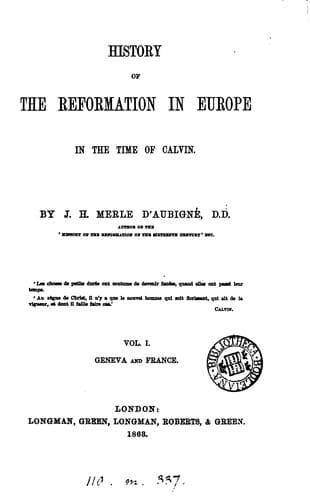
History of the Reformation in Europe in the Time of Calvin, Vol. 8 (of 8)Merle d'Aubigné, J. H. (Jean Henri)
History
History of the Reformation in Europe in the Time of Calvin, Vol. 8 (of 8)
Merle d'Aubigné, J. H. (Jean Henri)
Reformation
longer be possible to discern the way of salvation; moral force would
disappear, freedom would depart, modern civilization would once more
sink into barbarism, and humanity, deprived of the only guide competent
to lead it on, would go astray and perish hopelessly in the desert.
We have narrated in our early volumes the great achievements of the
Reformation in Germany, at Worms, Spire, Augsburg, and elsewhere. While
these events were astonishing all Europe, the Spirit of God was gently
breathing, souls were silently awakening, churches were forming, and
the Christian virtues were springing up afresh in Christendom. What
took place at that period was very much like what frequently happens
in the world of nature. In the higher regions there are great gales,
clouds charged with electricity, thunders, lightnings, and torrents of
rain. Then in the lower regions, in the valleys and on the plains, the
fields refreshed, reviving, grow green again, 'and the earth brings
forth first the fruit, then the ear, after that the full corn in the
ear.'
The Reformation had made great progress in Germany. The Word of God
everywhere advanced with much power; and the waters which had gushed
forth at Wittenberg, spreading around, quenched the thirst of many
souls. Believers were found in all classes, but especially among the
traders of the towns.
[Sidenote: JOHN BUGENHAGEN.]
In an island of the Baltic, formed by the two eastern arms of the
Oder, and belonging to Pomerania, stands the small town of Wollin,
formerly a nest of Danish pirates. Here was born, on June 24, 1485, a
man of singular goodness, who became one of the champions of Christian
civilization in the sixteenth century, John, son of the councillor
Gerard Bugenhagen. He entered in 1502 the university of Greifswald,
a town situated on the same sea, and applied himself to the study
of languages, the humanities, and also theology. In 1505 he went
to Treptow, another town on the Baltic, further eastward, and was
appointed rector of the school. He was so successful as a teacher
that Bodelwin, abbot of a neighboring convent, invited him to become
professor of theology in a college instituted for the teaching of the
sciences. Here he expounded the Scriptures, for the most part according
to the views of Augustine and Jerome. Priests, monks, and townsmen came
to hear him; and although he was not ordained, his friends strongly
urged him to preach. This he did, to the great delight of his hearers,
among whom were some of noble rank.[481]
'Alas!' said Bugenhagen, afterwards, 'I was still in the strait bonds
of pharisaic piety, and I had no true understanding of the Holy
Scriptures. We were all so deeply sunk in the doctrine of the pope,
that we had not even a wish to know the doctrine of the Word of God.'
There were however desires and longings in his heart; but what he
wanted remained as a writing in cipher, of which he was unable to
discover the key. It was quite suddenly at last that he found it.
Public-domain text, read in full here on John Shaqi.
Reviews
Reviews
No reviews yet
Be the first to share your thoughts on this work.
Elsewhere in the archive
Join the Discussion
Join the discussion
Sign in to leave a comment or review.
Sign InorCreate an account