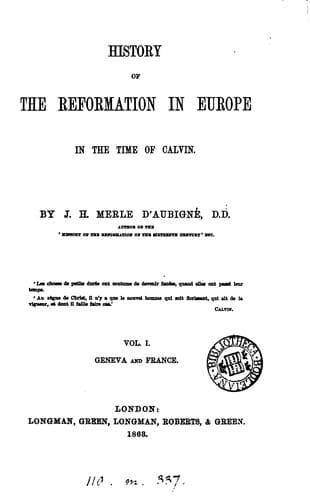
History of the Reformation in Europe in the Time of Calvin, Vol. 8 (of 8)Merle d'Aubigné, J. H. (Jean Henri)
History
History of the Reformation in Europe in the Time of Calvin, Vol. 8 (of 8)
Merle d'Aubigné, J. H. (Jean Henri)
Reformation
The Reformation met with difficulties in the principality of Anhalt,
but the young princes who now ruled the two duchies of which the
principality consisted, had had a pious mother, and the seed which
her hand had sown in their hearts overcame all obstacles. One of the
princes, Wolfgang, had held intercourse with Luther as early as 1522
and had, as we have seen, most willingly signed the Confession of
Augsburg.[490] The other three, however, had not followed his example.
John, on the contrary, had signed the Compromise of Augsburg, and it
was not easy for him to draw back. Surrounded by powerful neighbors
entirely devoted to Rome, the elector of Brandenburg, Duke George
of Saxony, and the archbishop elector of Mentz, it seemed scarcely
possible for them to extricate themselves from the net. Joachim
was of a feeble and gloomy temper. Moreover, Prince George was an
ecclesiastic at the age of eleven, a canon of Merseburg since 1524,
and provost of the chapter of Magdeburg, and seemed to be called to
the highest offices of the church. He was born at Dessau in 1501. From
his childhood he had shown a strong attachment to church ceremonies
and to the traditions of the fathers; and the doctrines of Luther
were afterwards depicted to him in the blackest colors. 'This man,'
they told him, 'proscribes good books, authorizes bad ones, and
abolishes all the holy ordinances. All his followers are Donatists
and Wickliffites.' He was henceforth a vehement opponent of a system
which, according to his judgment, was destructive of Christianity.
When the ministers of Magdeburg attempted to win over the members of
the Chapter to the Reformation, he roughly rebuked them. As he was an
honest man and was desirous of qualifying himself to contend against
the errors of the Protestants, he began to search for arguments in
the Holy Scriptures and in the fathers of the church, but it was
not possible for him to find any. On the contrary, he was utterly
astonished to find that Holy Scripture was opposed to many of the
established customs of the church; and that in what was called the new
doctrine there were many articles which were found in the Bible, and
which had been held by the fathers. His mother, although she continued
in the church and counselled her sons not to violate its unity, had
believed that she was saved by grace alone, and had with special
emphasis professed this faith at the time of her death. George had
embraced this faith at an early age; and the bishop of Merseburg had
confirmed him in it by rebuking one day a preacher who had exalted
human merits, and to whom he had said energetically: 'Not a single
living man is righteous.' He repeated the words three times in the
presence of George; and now George found the doctrine distinctly
asserted in the sacred writings. He wondered within himself whether it
could be on this account that the friends of Rome spoke of the Bible
as a heretical book and forbade people to read it. But at other times
Public-domain text, read in full here on John Shaqi.
Reviews
Reviews
No reviews yet
Be the first to share your thoughts on this work.
Elsewhere in the archive
Join the Discussion
Join the discussion
Sign in to leave a comment or review.
Sign InorCreate an account