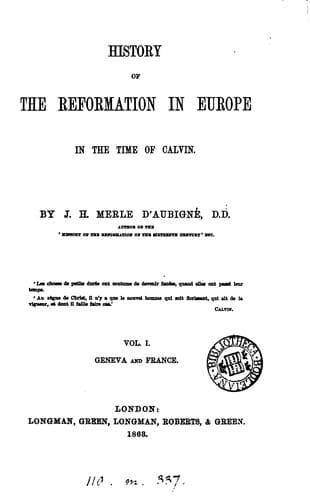
History of the Reformation in Europe in the Time of Calvin, Vol. 8 (of 8)Merle d'Aubigné, J. H. (Jean Henri)
History
History of the Reformation in Europe in the Time of Calvin, Vol. 8 (of 8)
Merle d'Aubigné, J. H. (Jean Henri)
Reformation
recognizing in it this truth, of which God had kept alive a spark in
his heart,[491] he was not a little alarmed, for he saw that it was
the very doctrine of Luther. 'I see,' he said to himself, 'that the
fathers very much praised the Holy Scriptures, considered them the
foundation, and would have no other.' And now the doctors of the church
refuse to test their teaching by Scripture! He therefore put to some of
them the question on what basis the doctrines of the church were made
to rest; and they could not tell him. He observed at the same time,
in many of those who defended abuses, spiteful passions, injustice,
and calumny; and honest George was at a loss what to think about it.
He fell into a deep melancholy, a state of restlessness and distress
of mind which nothing could relieve.[492] 'On the one hand,' said he,
'I see the building threatening to fall; on the other I see troubles,
disagreements, and the revolt of the peasants.' Luther had indeed
opposed this revolt; but, for all that, the prince was terrified and
in great distress. 'What shall I do? Which side must I take? God grant
that I may determine to do only that which is right, and resolve not
to act against my own conscience.' He was haunted by these thoughts
day and night. At a later time he said: 'How many a night have I been
agitated and depressed, suffering unutterable heaviness of heart.
Something dreadful appeared before me; He knows, from whom nothing is
concealed. My whole being shuddered. How often this passage came into
my mind,--"The sword without, and terrors within." I could do nothing
else but cry unto God, as a poor sinner who supplicates his grace.'
In 1530 he received a copy of the Confession of Augsburg, which
Wolfgang had signed. He had up to this time read very little the
writings of the reformers; and he found that the evangelical doctrine,
as set forth in this document, was entirely different from what had
been told him. The fundamental doctrines of the apostolical churches
were clearly asserted in it, and the ancient heresies were convincingly
refuted. The refutation of the Protestant Confession drawn up by the
Roman doctors disgusted him. He now began to read the works of Luther,
and was struck by the fact that the author exhorted men to good works,
although he would have no one place confidence in them. He found,
indeed, that Luther was sometimes rather fiery; 'but,' said he, 'so are
Jeremiah, Isaiah, Ezekiel and other prophets.' He found that the Gospel
of Christ was again in the pulpits. He recollected that his mother had
one day said to him with sorrow,--'How is it that our preachers, when
they have to speak of the Gospel of Christ, do so with less warmth than
the new ministers?' And he thought within himself,--'While the poor
people to whom the cowl of St. Francis, satisfaction, and their own
merits are recommended, die wretchedly, those who are now directed to
Jesus Christ leave this world with joyful hearts.'
[Sidenote: HIS ZEAL FOR THE TRUTH.]
Public-domain text, read in full here on John Shaqi.
Reviews
Reviews
No reviews yet
Be the first to share your thoughts on this work.
Elsewhere in the archive
Join the Discussion
Join the discussion
Sign in to leave a comment or review.
Sign InorCreate an account