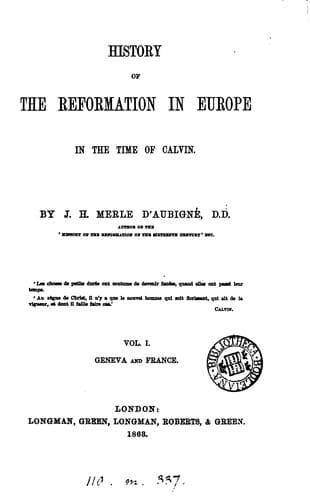
History of the Reformation in Europe in the Time of Calvin, Vol. 8 (of 8)Merle d'Aubigné, J. H. (Jean Henri)
History
History of the Reformation in Europe in the Time of Calvin, Vol. 8 (of 8)
Merle d'Aubigné, J. H. (Jean Henri)
Reformation
Ere long this prince, who was subsequently known as George the Pious,
showed himself zealous for the truth, and gained over his brothers John
and Joachim to the Gospel. On Holy Thursday, 1532, when a Dominican
who preached at Dessau had vigorously contended against the practice
of administering the Supper in both kinds, George dismissed him. The
three brothers now gave complete freedom to the Reformation. Duke
George of Saxony took care to warn them that they would draw upon
themselves the Emperor's displeasure, and that George would not attain
to the high honors which he had had reason to hope for. But all this
was ineffectual. Towards the close of the summer, Luther wrote to the
princes in the following terms: 'I have heard, illustrious princes,
that by the power of the Spirit of Christ an end has been put in your
dominions to impious abuses, and that you have introduced the practices
of Christian communion, not without exposing yourselves to great danger
and to the threats of powerful princes. I give God thanks that He has
imparted to the three brothers the same spirit and the same strength.
Christ, the "weak" king, is in truth and forever the king almighty, and
such are the works which he accomplishes. He acts, he lives, he speaks,
both in himself and in his members. The beginnings of every work of God
are weak, but the results are invincibly strong. The roots of all trees
are at first mere slender filaments, or rather a sort of pulp which
solidifies; nevertheless from them are produced those huge trees, those
oaks, of which are constructed vast buildings, ships and machines.[493]
Every work of God begins in weakness and is completed in strength. It
is otherwise with the works of men.' On September 14, Luther sent his
friend Hausmann to the princes as pastor, 'a man who loves the Word
of God and teaches it with discretion.' Prince George, on the ground
of his ecclesiastical offices, considered himself to be invested with
a legitimate authority in the church of his own dominions. Luther
calls him 'right reverend bishop.' When he heard how much George had
to suffer 'on the part of Satan, the world, and the flesh,' and that
machinations of all kinds were set on foot for attacking him, he made
haste to fortify him, writing to him as follows:--'Christ himself hath
said--"Be of good comfort, I have overcome the world." If the world be
overcome, so likewise is the prince of the world; for when a kingdom is
conquered the king also is conquered. And if the prince of this world
be conquered, all that proceeds from him shares his defeat,--fury,
wrath, sin, death, hell, and all the arms in which he confidently
trusted. Glory be to God, who hath given us the victory.'[494]
[Sidenote: PRINCE JOACHIM.]
Public-domain text, read in full here on John Shaqi.
Reviews
Reviews
No reviews yet
Be the first to share your thoughts on this work.
Elsewhere in the archive
Join the Discussion
Join the discussion
Sign in to leave a comment or review.
Sign InorCreate an account