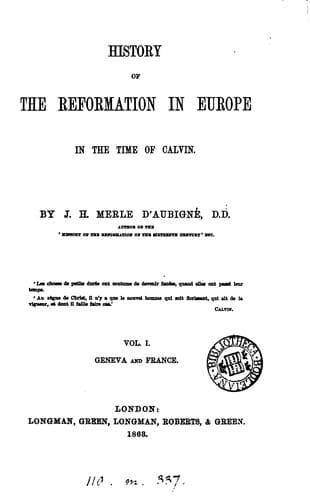
History of the Reformation in Europe in the Time of Calvin, Vol. 8 (of 8)Merle d'Aubigné, J. H. (Jean Henri)
History
History of the Reformation in Europe in the Time of Calvin, Vol. 8 (of 8)
Merle d'Aubigné, J. H. (Jean Henri)
Reformation
We have elsewhere treated of the reformation of Bremen, of Augsburg,
and of Würtemberg. Pomerania was not yet reformed, although Pomeranus,
the reformer to whom it had given birth, took so prominent a part in
the work in many towns and countries. The duke, Bogislas, and the
bishop of Camin were resolutely opposed to the Reformation; but here
and there amongst the townsmen were ardent aspirations towards the
Gospel; and occasionally, likewise, there were excesses and destruction
of images. The clergy and the nobles were on the side of the pope;
the towns were for the Bible; and the two camps were almost at war.
The duke on his travels, in 1523, passed through Wittenberg, and the
bishop of Camin, as curious as the duke, appears to have accompanied
him. The reformer in his sermon spoke, amongst other things, of the
carelessness and luxury of bishops. The duke smiled and looked at
his companion.[497] Bogislas sent for Luther, conversed with him in
a friendly manner, and said: 'I should like for once to confess to
you.' 'I am quite willing,' said the reformer; 'my only fear is that
as your Highness is a great prince, you are also a great sinner.' The
duke made frank reply that this was only too true. The duke felt also
the influence of his son, the young prince Barnim, who had studied at
Wittenberg from 1518 to 1521, and who had attended the disputation
at Leipsic in 1519. His brother George, on the other hand, brought
up at the court of Duke George of Saxony, had there imbibed a hatred
of the Gospel. After the death of Bogislas, these two princes became
leaders of the two opposing parties. Barnim sent word to the allies of
Smalcalde--'What my brother builds up, I shall cast down.' The mother
of George appeared friendly to his purpose; and her son Philip having
come to an understanding with Barnim, a diet was convoked, in 1533, at
Treptow. The towns laid before it a scheme of reformation, which was
well received; and Pomeranus was summoned to settle the new order of
things. The nobility, however, and the clergy, particularly the bishop
of Camin, still energetically opposed the evangelical work.
[Sidenote: WESTPHALIA.]
Public-domain text, read in full here on John Shaqi.
Reviews
Reviews
No reviews yet
Be the first to share your thoughts on this work.
Elsewhere in the archive
Join the Discussion
Join the discussion
Sign in to leave a comment or review.
Sign InorCreate an account