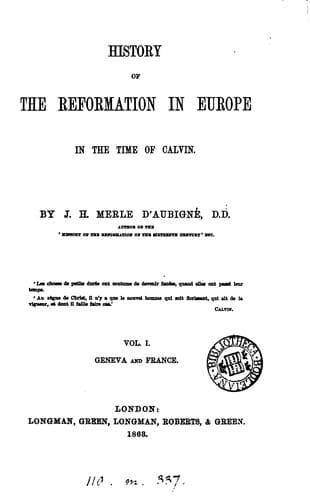
History of the Reformation in Europe in the Time of Calvin, Vol. 8 (of 8)Merle d'Aubigné, J. H. (Jean Henri)
History
History of the Reformation in Europe in the Time of Calvin, Vol. 8 (of 8)
Merle d'Aubigné, J. H. (Jean Henri)
Reformation
The conflict was severe in Westphalia.[498] Evangelical truth was
well received in some places. Children used to sing Luther's hymns at
the doors of houses; the members of a family would sing them by the
fireside; the most fearless ventured to do the same in the open air, at
first in the evening twilight, and then in the daytime. At length some
ministers arrived. Monks and nuns were now seen quitting their convents
and embracing the Gospel. At other places, as for instance at Lemgo,
the pastor, at first stoutly opposed, would set out for some reformed
town in order to see how matters were going on there, and on his return
would reform his own church. But in some districts violent resistance
was offered. At Soest, a conflict took place between a victim and the
executioner. The latter having made an ineffectual stroke and inflicted
only a severe wound, the victim, a robust man of the lower class,
snatched away the weapon, repulsed the executioner and his assistant,
and was carried off in triumph by the crowd to his own house, where,
however, he died on the following day, of the blow which he had
received.
[Sidenote: THE SPIRITUALS.]
In other places a struggle between cruelty and humanity took place
among the persecutors, and on some occasions humanity triumphed. At
Paderborn, a town in which Charlemagne held several diets and where
many Saxons were baptized, the community without asking leave of higher
authorities had opened the churches to evangelical preaching. Hermann,
elector of Cologne, who subsequently entertained very different views,
being named administrator of the bishopric, arrived in the town
attended by guards and by influential men of the country who were
devoted to the papacy. Appealed to by these men, by the chapter, and
by the council which implored him to punish the illegal proceedings
of the townsfolk, he allowed at first things to take their course.
The people were, however, called together in the garden of a convent
at which the elector was staying. They were told that he was desirous
of taking a gracious leave of them. The townsfolk arrived; but they
suddenly found themselves encompassed by armed men, and the leaders of
the evangelical party were seized and cast into prison. They were put
to the torture; they were led out to the scaffold, around which the
people were gathered, and the approaches to which were covered with
gravel intended to absorb the blood of the victims, and there sentence
of death was read to these honest and pious citizens. Nothing now
remained but to behead them. The chief executioner came forward and,
turning to Hermann and all the dignitaries around him, said: 'These men
are innocent, I would sooner die than behead them.' At the same time
a voice was heard from the midst of the crowd; it was that of an aged
man who came forward with difficulty, leaning on his staff. 'I also
am guilty like those you have condemned, and I ask to be put to death
Public-domain text, read in full here on John Shaqi.
Reviews
Reviews
No reviews yet
Be the first to share your thoughts on this work.
Elsewhere in the archive
Join the Discussion
Join the discussion
Sign in to leave a comment or review.
Sign InorCreate an account