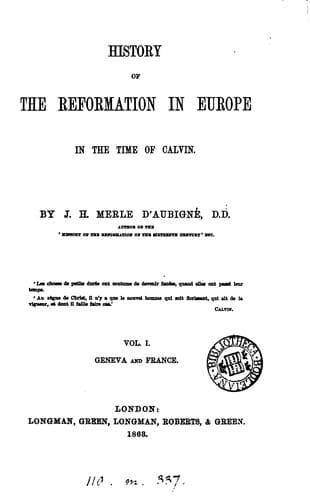
History of the Reformation in Europe in the Time of Calvin, Vol. 8 (of 8)Merle d'Aubigné, J. H. (Jean Henri)
History
History of the Reformation in Europe in the Time of Calvin, Vol. 8 (of 8)
Merle d'Aubigné, J. H. (Jean Henri)
Reformation
These successive defeats made an impression on Bockhold and his
partisans. They lost all hope of aid from Holland. The landgrave,
Philip of Hesse, one of the most powerful chiefs of Protestantism,
had brought up his forces to put an end to the scandals of Munster.
The bishop of this city, impelled by the desire to reconquer it,
had assembled for the purpose some Roman Catholic soldiers. One of
Bockhold's men escaped from the town and pointed out the way to capture
it.[528] In the night of June 24, 1535, two hundred lansquenets cleared
the foss and scaled the wall at a point where it was very low. They
were no sooner within the town, than they uttered cries and beat the
drum. The men of the king of Zion leaped out of their beds and ran to
arms. The conflict began and was for a moment doubtful; but one of the
city gates having been opened from within, the army of the besiegers
entered and the fight became terrible. A hundred and fifty horse or
foot soldiers lost their lives. On the side of the besieged many also
fell, and amongst others Rottmann who, resolved not to suffer the
disgrace of captivity, threw himself with intrepidity into the midst of
the fire and perished. The king and two of his principal counsellors,
Knipperdolling and the pastor Crechting, made their escape and hid
themselves in a strong tower, where they hoped to escape the notice
of the conquerors.[529] But the soldiers penetrated into their place
of concealment, dragged them out and made them prisoners. Bockhold at
first braved it out, and assuming the air of a king spoke arrogantly
to the bishop. Two theologians of Hesse endeavored to bring him to
repentance; but he obstinately held to his opinion, admitting no
superior to himself on earth. Reflection, however, wrought a change.
Bockhold was not a fanatic, but an impostor; and he felt that the only
way to save his life was to abjure his errors. He asked for a second
conference with the two Hessians and feigned conversion. 'I confess,'
he said to them, 'that the resistance I have offered to authority
was unlawful; that the institution of polygamy was rash, and that
the baptism of children is obligatory. If pardon should be granted
me, I pledge myself to obtain from all my adherents obedience and
submission.' He likewise acknowledged that he had deserved to die ten
times over. This was the behavior of a knave, willing to abandon even
his imposture, if, by so doing, he might save his life. Knipperdolling
and Crechting, on the contrary, persisted in their views, and asserted
that they had followed the guidance of God. Cruelty of various kinds
was inflicted on these wretched men. They were led about publicly,
during the month of their detention, like strange animals, as a
spectacle to the several princes and their courts, to whom they and
their pretended king were made a subject of ridicule.[530] Bockhold did
not derive from his confessions the advantage which he expected. The
Public-domain text, read in full here on John Shaqi.
Reviews
Reviews
No reviews yet
Be the first to share your thoughts on this work.
Elsewhere in the archive
Join the Discussion
Join the discussion
Sign in to leave a comment or review.
Sign InorCreate an account