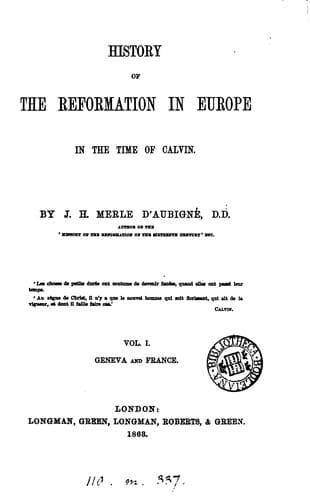
History of the Reformation in Europe in the Time of Calvin, Vol. 8 (of 8)Merle d'Aubigné, J. H. (Jean Henri)
History
History of the Reformation in Europe in the Time of Calvin, Vol. 8 (of 8)
Merle d'Aubigné, J. H. (Jean Henri)
Reformation
The inquisitors did not stop here. Rodrigo de Valerio, after having
been set at liberty, on the ground, they said, that he was merely mad,
had refrained, by the desire of his friends, from publicly preaching
the Gospel. Unwilling, however, to do absolutely nothing, he had
gathered together a certain number of his friends and had in a familiar
way interpreted to them the Epistle of St. Paul to the Romans, that
ocean, as Chrysostom called it, which meets us everywhere at the
beginning of the awakenings.[68] Some of those who listened to him
persevered in the faith; others, at a later time, rejected it. Among
the latter in particular was Peter Diaz, who having forsaken the Gospel
entered the Society of Jesuits and died at Mexico.[69] But the brave
Rodrigo could not long submit to this restriction. Ought he to shrink,
he said to himself, from exposing his liberty, or even his life, when
the Gospel was at stake? Others had given their lives for a less object
than this. He was in hope, moreover, of arousing by his own example
other combatants who should finally win the victory. He, therefore,
laid aside timid precautions and began again to point out publicly the
errors and superstitions of Rome. He was once more denounced, and was
arrested by the Inquisition, which was quite determined this time not
to let slip the pretended madman. He was sentenced to imprisonment for
life and to wear the _san benito_, a cloak of a yellow color, the usual
garb of the victims of the Inquisition. Every Sunday and feast-day,
Valerio was taken, as well as other penitents, by the familiars of the
holy office to Saint Saviour's Church, at Seville, to hear both the
sermon and the high mass. He appeared as a penitent without repentance.
He could not listen to the doctrine of the monks without in some way
showing his opposition to it. He would sometimes rise from his seat,
and, while the whole assembly fixed their eyes on him, put questions
to the preacher, refute his doctrines, and entreat his hearers to take
care they did not receive them.[70] Rodrigo could not hear a doctrine
contrary to the Gospel without his whole soul being stirred within him.
The inquisitors, steadily persuaded of his madness, at first excused
these interpellations, which to them seemed to be the clearest proof of
his malady. But the discourses of this insane man were so reasonable
that they produced an impression. The inquisitors at length confined
him in a convent on the coast of San Lucar, where all society was
forbidden him; and here he died at about the age of fifty. His _san
benito_ was exhibited in the metropolitan Church of Seville, with this
inscription:--_Rodrigo Valerio, a false apostle who gave out that he
was sent of God_. It was after the departure of de la Fuente from
Seville that the final sentence was pronounced against Valerio.
CHAPTER III.
SPAIN OUT OF SPAIN.
(1537-1545.)
Public-domain text, read in full here on John Shaqi.
Reviews
Reviews
No reviews yet
Be the first to share your thoughts on this work.
Join the Discussion
Join the discussion
Sign in to leave a comment or review.
Sign InorCreate an account