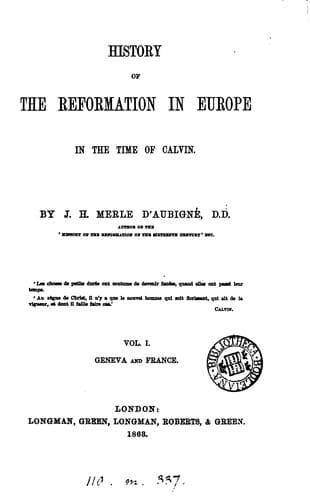
History of the Reformation in Europe in the Time of Calvin, Vol. 8 (of 8)Merle d'Aubigné, J. H. (Jean Henri)
History
History of the Reformation in Europe in the Time of Calvin, Vol. 8 (of 8)
Merle d'Aubigné, J. H. (Jean Henri)
Reformation
At Paris, Francis had found, as we have stated, his elder brother
James, who had gone thither by his father's command to complete his
studies; and it is possible that this interview may have been the
real purpose of his journey. James had, like his brother, a noble and
independent mind, a sensitive conscience, and a pure and innocent
nature which unsuspectingly showed itself as it was. This openness of
character exposed him to great danger. To these qualities he added
a very refined taste, which enabled him to appreciate instinctively
the works of intellect and the productions of art. James was already
convinced of the great truths of the Gospel, but his faith was
strengthened during his stay at Paris; and he exerted a beneficial
influence on some of his fellow-countrymen who were studying there at
the same time.
[Sidenote: MARTYRDOM OF LEPEINTRE.]
In this capital he did not find every thing answering to his
expectation. The professors were mostly bigots, who had a very small
stock of knowledge, but nevertheless assumed a consequential air,
although the little philosophy which they possessed made them really
less intelligent than if they had had none at all. The students had
little good-breeding, nor did they show any desire for really liberal
researches. James Enzinas was deeply moved by the heroism of the
martyrs, and the cruelty of their executioners made him shudder. One
day a very young man named Claude Lepeintre, about twenty years of
age, was conducted to the Place Maubert, to suffer there the last
penalty. He had resided three years at Geneva, serving, it appears, an
apprenticeship to a goldsmith. In that city he had found the Gospel.
After his return to Paris, his native place, 'he had endeavored to
impart to his friends the knowledge of eternal salvation.' Some people
of the house in which he carried on his trade as a goldsmith 'could
not endure the sweet savor of the Gospel of the Son of God,' and
therefore took him before the criminal judge, who condemned him to be
burnt alive. He appealed to the parliament, which, as Claude refused to
recant, added that he should forthwith have his tongue cut out. Without
change of countenance the pious young Christian presented his tongue to
the executioner, who seized it with pincers and cut it off. It is even
added that with it he struck the martyr several blows on the cheek. He
was then placed in a car to be taken to the stake. Several evangelical
Christians, students and others, such as James Enzinas, his friend the
advocate Crespin, and Eustace of Knobelsdorf, would not leave him till
his death. His martyrdom was described by all three of them. While on
his way to the Place Maubert he was subjected, say these eye-witnesses,
to 'numberless insults which they cast at him. But it was wonderful
to see his self-possession and constancy, and how he passed on with
a light heart. It might have been thought that he was going to a
Public-domain text, read in full here on John Shaqi.
Reviews
Reviews
No reviews yet
Be the first to share your thoughts on this work.
Join the Discussion
Join the discussion
Sign in to leave a comment or review.
Sign InorCreate an account