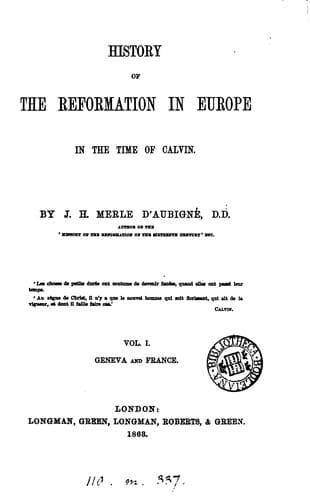
History of the Reformation in Europe in the Time of Calvin, Vol. 8 (of 8)Merle d'Aubigné, J. H. (Jean Henri)
History
History of the Reformation in Europe in the Time of Calvin, Vol. 8 (of 8)
Merle d'Aubigné, J. H. (Jean Henri)
Reformation
Carranza's teaching, perhaps, contributed to make the Gospel attractive
to younger minds at Valladolid. At first they showed some timidity;
but the cruel death of one of the most earnest Spanish Christians
inspired them, about the middle of the century, with more zeal and
courage. Among the disciples of Carranza was Don Domingo de Roxas,
son of the marquis of Poza--a name rendered illustrious by a great
poet--and whose mother was a daughter of the count of Selinas. This
young man, who was destined by his parents for the church, was amiable,
upright, a lover of truth, keenly susceptible and impressible, endowed
likewise with courage, but not with that immovable firmness which
belongs to powerful characters. He listened with enthusiasm to the
lectures of Carranza, who in certain cases made use of the phrases
of the reformers, while condemning their doctrines. The same was
afterwards done by the Council of Trent, to which Carranza was sent
as delegate by Charles the Fifth. He used to say that man, since his
fall, could not be justified by the power of nature; but that he is
justified by Jesus Christ. To these assertions, however, he added
explanations which weakened them. 'The moral power of man,' he said,
'is indeed diminished but not destroyed; he is able to incline himself
to righteousness, and faith justifies only so far as charity is added
to it.'
Ere long Domingo showed less timidity than his master. He laid
aside every thing that weakened the doctrine and embraced the pure
faith drawn from the Word of God. At the same time that he listened
to Carranza he was reading Luther and Melanchthon, and he thought
their doctrines more evangelical and more powerful than those of his
master. The professor trembled lest his disciple should become a
heretic and should raise up others. What to Roxas appeared a friendly
light, seemed to Carranza the signal of a conflagration. In vain
he endeavored to prove to young de Roxas the mass and purgatory.
The latter, understanding that the truth was the property of all,
communicated it to those around him. He put into circulation the works
of the reformers; he composed others himself. Among the latter was an
'Exposition of the Faith.' By these means he gained over to the Gospel
several inhabitants of Valladolid. He encountered opposition on the
part of some members of his own family; but he found access to others,
as well as to several noble houses of Castile.[181]
[Sidenote: AUGUSTINE CAZALLA.]
Public-domain text, read in full here on John Shaqi.
Reviews
Reviews
No reviews yet
Be the first to share your thoughts on this work.
Elsewhere in the archive
Join the Discussion
Join the discussion
Sign in to leave a comment or review.
Sign InorCreate an account