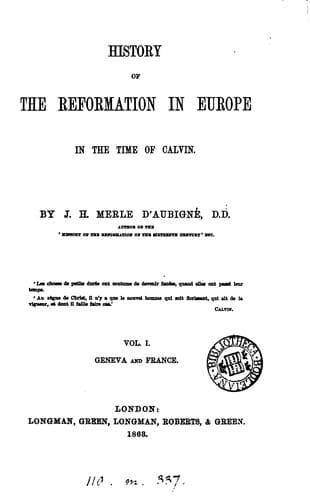
History of the Reformation in Europe in the Time of Calvin, Vol. 8 (of 8)Merle d'Aubigné, J. H. (Jean Henri)
History
History of the Reformation in Europe in the Time of Calvin, Vol. 8 (of 8)
Merle d'Aubigné, J. H. (Jean Henri)
Reformation
Another young Castilian, Augustine Cazalla, a contemporary of Roxas,
at the age of seventeen had had Carranza as his confessor; and he
attended, at the same time as Domingo, the lectures of this illustrious
master at the college of St. Gregory at Valladolid. His father was
director of the royal finances, and his mother Leonora (whose maiden
name was de Vibero), a friend of the friends of the Gospel, opened her
house to them, and freely welcomed the refugees who were driven by
persecution from their own abodes. On this account the house of Leonora
was afterwards razed, and on its ruins fanaticism erected a monumental
stone, which remained there till our own days.[182] Cazalla completed
his studies at Alcala, became canon of Salamanca, and attained a
position in the first rank of Spanish preachers. The circumstances in
which he was placed, and particularly the hospitality of his mother,
prepared him to receive the Gospel. He was even accused of having
'openly taught in the Lutheran conventicles of Valladolid.' It appears,
however, that he did not publicly declare himself for the Word of God
until the emperor, having nominated him his preacher and almoner, took
him with him into Germany, where he had frequent intercourse with the
Lutherans.[183]
Even before Cazalla decided for the Gospel Don Domingo de Roxas had
found a powerful assistant in the evangelization of Valladolid and its
neighborhood. An Italian noble, Don Carlos de Seso, born at Verona, of
one of the first families of the country, had distinguished himself
in the service of the emperor, and had, it seems, learnt something
at an early age of the doctrine of the Reformation. He settled in
Spain, and during his residence at Valladolid became intimate with
the evangelical Christians of that city. He had a cultivated mind,
great nobility of character, gentlemanly manners, and much zeal for
the truth. Having become a Spaniard, he discharged in his adopted
country certain civil functions; and this afforded him opportunities
of diffusing with more freedom the knowledge of the Gospel. He did
this zealously in some towns situated to the east of Valladolid, on
the banks of the Douro; at Toro, where this river is spanned by the
numerous arches of an immense bridge, and where Seso was _corregidor_;
and, somewhat further eastward, in the melancholy and sombre Zamora,
which the Cid had reconquered from the Moors, and where the ruins of
his palace were to be seen. His active exertions were next put forth
in another quarter. We find him proclaiming the love of God in Jesus
Christ at Valencia, to the north of Valladolid, and under the very
walls of its beautiful cathedral. He afterwards married Doña Isabella
de Castilla, niece of the bishop of Calahorra, and a descendant of
King Pedro the Cruel, and took up his abode at Villa Mediana. Here he
became very successful in the evangelization of Logroño, and the rich
and fertile districts lying around, which are watered by the Ebro. Don
Public-domain text, read in full here on John Shaqi.
Reviews
Reviews
No reviews yet
Be the first to share your thoughts on this work.
Elsewhere in the archive
Join the Discussion
Join the discussion
Sign in to leave a comment or review.
Sign InorCreate an account