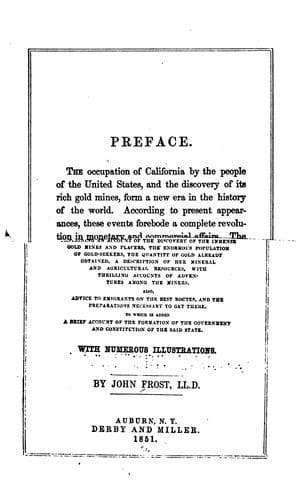
History of the State of California: From the Period of the Conquest by Spain to Her Occupation by the United States of AmericaFrost, John
History
History of the State of California: From the Period of the Conquest by Spain to Her Occupation by the United States of America
Frost, John
California -- Gold discoveries; California -- History
"The rivers, in forming their channels, or breaking their way through
the hills, have come in contact with the quartz containing the gold
veins, and by constant attrition cut the gold into fine flakes and
dust, and it is found among the sand and gravel of their beds at those
places where the swiftness of the current reduces it, in the dry
season, to the narrowest possible limits, and where a wide margin is,
consequently, left on each side, over which the water rushes, during
the wet season, with great force.
"As the velocity of some streams is greater than that of others, so is
the gold found in fine or coarse particles, apparently corresponding
to the degree of attrition to which it has been exposed. The water
from the hills and upper valleys, in finding its way to the river, has
cut deep ravines, and, wherever it has come in contact with the
quartz, has dissolved or crumbled it in pieces.
"In the dry season, these channels are mostly without water, and gold
is found in the beds and margins of many of them in large quantities,
but in a much coarser state than in the rivers; owing, undoubtedly, to
the moderate flow and temporary continuance of the current, which has
reduced it to smooth shapes, not unlike pebbles, but has not had
sufficient force to cut it into flakes or dust.
"The dry diggings are places where quartz containing gold has cropped
out, and been disintegrated, crumbled to fragments, pebbles, and dust,
by the action of water and the atmosphere. The gold has been left as
it was made, in all imaginable shapes; in pieces of all sizes, from
one grain to several pounds in weight. The evidences that it was
created in combination with quartz are too numerous and striking to
admit of doubt or cavil. _They are found in combination in large
quantities._
"A very large proportion of the pieces of gold found in these
situations have more or less quartz adhering to them. In many
specimens, they are so combined they cannot be separated without
reducing the whole mass to powder, and subjecting it to the action of
quicksilver.
"This gold, not having been exposed to the attrition of a strong
current of water, retains, in a great degree, its original
conformation.
"These diggings, in some places, spread over valleys of considerable
extent, which have the appearance of an alluvion, formed by washings
from the adjoining hills, of decomposed quartz and slate earth, and
vegetable matter.
"In addition to these facts, it is, beyond doubt, true that several
vein-mines have been discovered in the quartz, from which numerous
specimens have been taken, showing the minute connection between the
gold and the rock, and indicating a value hitherto unknown in
gold-mining.
"These veins do not present the appearance of places where gold may
have been lodged by some violent eruption. It is combined with the
quartz, in all imaginable forms and degrees of richness.
Public-domain text, read in full here on John Shaqi.
Reviews
Reviews
No reviews yet
Be the first to share your thoughts on this work.
Elsewhere in the archive
Join the Discussion
Join the discussion
Sign in to leave a comment or review.
Sign InorCreate an account