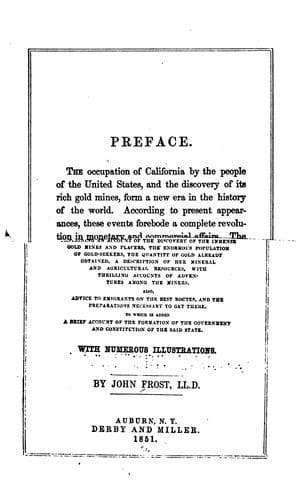
History of the State of California: From the Period of the Conquest by Spain to Her Occupation by the United States of AmericaFrost, John
History
History of the State of California: From the Period of the Conquest by Spain to Her Occupation by the United States of America
Frost, John
California -- Gold discoveries; California -- History
"The rivers present very striking, and, it would seem, conclusive
evidence respecting the quantity of gold remaining undiscovered in the
quartz veins. It is not probable that the gold in the dry diggings,
and that in the rivers--the former in lumps, the latter in dust--was
created by different processes. That which is found in the rivers has
undoubtedly been cut or worn from the veins in the rock, with which
their currents have come in contact. All of them appear to be equally
rich. This is shown by the fact that a laboring man may collect nearly
as much in one river as he can in another. They intersect and cut
through the gold region, running from east to west at irregular
distances of fifteen to twenty, and perhaps some of them thirty, miles
apart.
"Hence it appears that the gold veins are equally rich in all parts of
that most remarkable section of country. Were it wanting, there are
further proofs of this in the ravines and dry diggings, which
uniformly confirm what nature so plainly shows in the rivers."
It is an interesting inquiry--what was the amount of the golden
treasure collected during the years 1848 and '49? The satisfaction of
this inquiry will enable us to form some faint conception of the value
of the gold region, and the dependence which may be placed upon its
yield for a commercial return. Premising that the gold was first
discovered in May, 1848, and that intelligence of it was not received
in the United States till late in the following autumn, Mr. King, in
his report, proceeds in making an estimate of the quantity accumulated
till the close of 1849:
"No immigration into the mines could, therefore, have taken place from
the old States in that year. The number of miners was, consequently,
limited to the population of the territory, some five hundred men
from Oregon--Mexicans, and other foreigners, who happened to be in the
country, or came into it during the summer and autumn--and the
Indians, who were employed by or sold their gold to the whites.
"It is supposed there were not far from five thousand men employed in
collecting gold during that season. If we suppose they obtained an
average of one thousand dollars each--which is regarded by well
informed persons as a low estimate--the aggregate amount will be
$5,000,000.
"Information of this discovery spread in all directions during the
following winter; and, on the commencement of the dry season in 1849,
people came into the territory from all quarters--from Chili, Peru,
and other States on the Pacific coast of South America; from the west
coast of Mexico, the Sandwich Islands, China, and New Holland.
"The immigration from the United States came in last, if we except
those who crossed the Isthmus of Panama, and went up the coast in
steamers, and a few who sailed early on the voyage round Cape Horn.
Public-domain text, read in full here on John Shaqi.
Reviews
Reviews
No reviews yet
Be the first to share your thoughts on this work.
Elsewhere in the archive
Join the Discussion
Join the discussion
Sign in to leave a comment or review.
Sign InorCreate an account