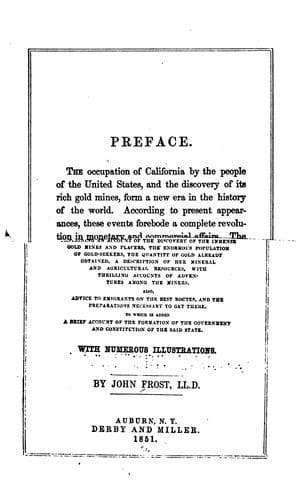
History of the State of California: From the Period of the Conquest by Spain to Her Occupation by the United States of AmericaFrost, John
History
History of the State of California: From the Period of the Conquest by Spain to Her Occupation by the United States of America
Frost, John
California -- Gold discoveries; California -- History
"Moving somewhat like a ship in a storm, rising and sinking
alternately at stern and bow, surmounting first one huge stone, then a
deep mud hole, then another stone, and then a small lake, my mule and
myself at last reached Crucis in the evening, the whole distance
traversed not being above twenty miles."[16]
The town of Crucis is a place very similar to Gorgona, but not so
large. The houses are built of cane and plastered with mud. No
attention is given to arrangement, and but a small portion is so
constructed as to bear any resemblance to a street. The climate is
unhealthy, and travellers from the United States make as short a stay
there as possible. Doubtless, with the increase of travel, the
character of the town and its accommodations will improve; but the
heat and humidity of the atmosphere, particularly just after the rainy
season, cause a great deal of injury to the health of people from the
United States, and will prevent any considerable settlement of
Anglo-Saxons in the town.
Panama, the terminus of the varied and difficult route across the
Isthmus, is situated on the shore of an extensive and beautiful bay.
It contains about eight thousand inhabitants, most of whom are
negroes. Being one of the old Spanish towns, upon the decline of the
Spanish power, the place fell into decay. The houses are generally of
stone or brick, two and three stories in height, whitewashed or
covered with a coat of plaster, and are invariably surrounded by a
balcony protected from sun and rain by the roofs of the houses
extending over them. The town is regularly arranged, the strait and
narrow streets intersecting each other at right angles. The
substantial character of the buildings as well as the evidences of
neglect and decay, strike the traveller at the same time. A wall was
built by the Spaniards, around the portion of the town nearest the
bay, but at least one half of the population reside beyond its limits,
and it is in a dilapidated state. A venerable, decayed, but still
imposing cathedral; a grand _plaza_, or open common--a general
characteristic of Spanish built towns; several churches, partly in
ruins; the ruins of the College of Jesuits, which cover a large
extent, and of two monasteries, of which the walls and bells alone
remain; and the frowning walls and towers of the battery, fronting the
bay, are the principal features of the town of Panama. Since the
commencement of the emigration to California, a number of Americans
have established hotels and eating-houses in the town, and good
accommodations are, therefore, to be obtained by travellers.
Public-domain text, read in full here on John Shaqi.
Reviews
Reviews
No reviews yet
Be the first to share your thoughts on this work.
Elsewhere in the archive
Join the Discussion
Join the discussion
Sign in to leave a comment or review.
Sign InorCreate an account