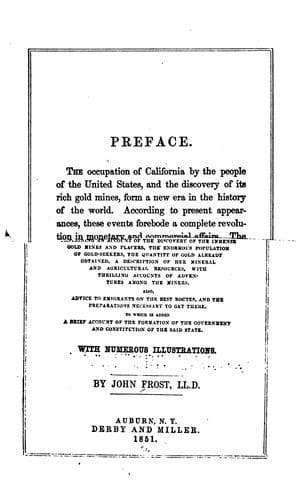
History of the State of California: From the Period of the Conquest by Spain to Her Occupation by the United States of AmericaFrost, John
History
History of the State of California: From the Period of the Conquest by Spain to Her Occupation by the United States of America
Frost, John
California -- Gold discoveries; California -- History
The atmosphere at Panama is particularly injurious to people from the
northern climes, and great care must be taken by travellers during
their stay at that place. It is best to avoid eating fruit altogether;
but, if indulged in, it should be in very inconsiderable quantities.
Exposure to the mid-day sun is a frequent cause of sickness among the
travellers, and should be avoided, as well as exposure to the rain.
During the rainy season, the _vomito_ is often prevalent among the
inhabitants of Panama, and is generally a fatal disease; but there is
a great deal less travel across the Isthmus during that season, on
account of the sickliness of the climate and the difficulties of the
route. A sort of bilious fever and dysentery are the most common forms
of disease among travellers from the north; but both may be avoided by
proper care.
From Panama, steamships of superior size and accommodation, convey
passengers to San Francisco. Starting from the front of the city, the
beautiful bay, with its semi-circular shores skirted with green
foliage and inclosed with high mountains, and the lofty islands of
Flamingo, Perico, Taboga, and others, present themselves to the view.
At the island of Taboga, all the vessels that come into the bay obtain
their supplies, and the Pacific Mail Steamship Company have
established their depot for coal, &c., on its shores. After obtaining
all the necessary supplies the steamship moves out of the bay,
rounding Point Mala. The voyage upon the Pacific, with all its variety
of incident and scenery, then commences. The principal annoyance of
travellers is the almost intolerable heat of the sun and furnaces of
the steamship united. Water-spouts and different species of whale are
frequent sights. North of the Gulf of Tehuantepec, the steamer nears
the land, and the bold mountain coast of Mexico breaks upon the view,
and, at night, the passengers enjoy a view of the glaring light
produced by the burning volcano of Colima; though the volcano itself
is but imperfectly seen being at the distance of ninety miles from the
vessel. Soon after this fades from the view, the islands off the town
of San Blas appear, and an immense white rock, isolated from the sea,
serving as a lighthouse to ships steering for the port. At San Blas,
the steamships remain some time, to obtain supplies of coal, fresh
fruits, and provisions. These indispensables having been procured, the
vessel proceeds upon her voyage. Cape Corientes next appears, and,
soon afterwards, the entrance to the Gulf of California is approached;
and then, Cape San Lucas, the extreme southern point of California,
with its mountains and rocky shores, is hailed by the traveller as the
first portion of the "promised land" that greets his sight. Passing
along the western coast of the peninsula, the island and bay of
Magdalena appear, with shores three or four thousand feet above the
sea. Next, the towering ridges of Cerros Isles are passed, and the
Public-domain text, read in full here on John Shaqi.
Reviews
Reviews
No reviews yet
Be the first to share your thoughts on this work.
Elsewhere in the archive
Join the Discussion
Join the discussion
Sign in to leave a comment or review.
Sign InorCreate an account