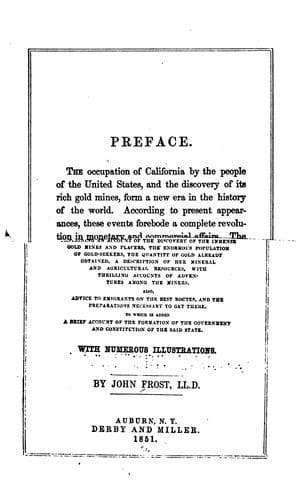
History of the State of California: From the Period of the Conquest by Spain to Her Occupation by the United States of AmericaFrost, John
History
History of the State of California: From the Period of the Conquest by Spain to Her Occupation by the United States of America
Frost, John
California -- Gold discoveries; California -- History
bold, rocky shores of the peninsula are in continual view. The change
of the temperature of the air is generally keenly felt by those who do
not take care to provide against it. Within a few days after leaving
Panama, the thermometer falls from 95° to 55°, and such a change must
have an injurious effect, if additional clothing is not put on to meet
it.
The first portion of Upper California, or, the "Golden Land," which
presents itself to the voyagers, is the Ceronados, two high,
round-topped rocks off the port of San Diego. Then the beautiful,
semi-circular harbor is entered, and if wanting, supplies are obtained
from the town. From the harbor of San Diego, the vessel proceeds along
the coast of California, and the towering peaks of the coast range of
mountains, engage the attention. The high promontory of St. Vincent is
passed, and then the open bay of Monterey is entered, and passengers
are either let off the steamer or taken aboard as necessity may
occasion. From Monterey the steamer keeps along the coast, and
mountainous shores alone meet the view, until the voyagers come in
sight of the Farallones, two large detached rocks at the southern side
of the entrance to the bay of San Francisco. Then the Golden Gate, as
the strait or entrance is called, is entered by the steamer, and the
perpendicular cliffs and hills upon each shore afford matter for
wonder. The strait is about three miles long, and from one to two
miles broad. As the vessel reaches its terminus, the great bay of San
Francisco opens to the view, looking like a miniature ocean. Bird
Island, Wood Island, Angel Island, with the beautiful little bay of
Sancelito, successively meet the gaze, and very soon the steamer is
anchored, having reached her destination. Such is the Isthmus route to
the "gold region." It is the shortest route, or the one which occupies
the least time in traversing, presents great variety, and upon the
whole, its beauties and pleasures outnumber the difficulties and
annoyances.
THE OVERLAND ROUTE.
We now proceed to give the general character and direction of that
which is considered the best land route to California, and which is
the most travelled by emigrants. The principal advantage possessed by
this route may be stated in a few words. It is the shortest route to
the bay of San Francisco and the gold region. The Indians upon the
route are friendly and very few acts of hostility have been committed.
The trail is plain and good where there are no physical obstructions.
To these must be added the certainty of the emigrants reaching their
place of destination, in good season; which will not exist, if new and
unexplored routes are attempted. The greatest calamities and
sufferings have been endured by those who have either taken an
entirely different route, or deviated from the line which we will
describe. Advice concerning the time of starting, preparations, &c.,
will be interspersed in the description.
Public-domain text, read in full here on John Shaqi.
Reviews
Reviews
No reviews yet
Be the first to share your thoughts on this work.
Elsewhere in the archive
Join the Discussion
Join the discussion
Sign in to leave a comment or review.
Sign InorCreate an account