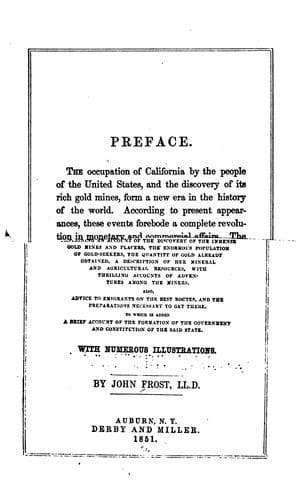
History of the State of California: From the Period of the Conquest by Spain to Her Occupation by the United States of AmericaFrost, John
History
History of the State of California: From the Period of the Conquest by Spain to Her Occupation by the United States of America
Frost, John
California -- Gold discoveries; California -- History
Various expeditions for exploring the coast of Upper California above
Cape Mendocino, were made by the Spaniards. One of these proceeded as
far north as the latitude of 41 degrees, and some men were landed on
the shores of a small bay, just beyond Cape Mendocino, and gave the
harbor the name of Port Trinidad. The small river which flows into the
Pacific near the place where they landed was called Pigeon River, from
the great number of those birds in the neighborhood of it. The Indians
appeared to be a peaceable and industrious race, and conducted
themselves towards the Spaniards in the most inoffensive manner. In
the same year, 1775, Bodega, a Spanish commander, returning from a
voyage extended as far north as the 58th degree of latitude,
discovered a small bay which had not previously been described, and he
accordingly gave it his own name, which it still retains. This Bay of
Bodega is situated a little north of the 38th degree of latitude.
Few events worth recording occurred in California, during the whole
period of fifty years, from the first establishment of the Spaniards
on the western coast till the termination of the Mexican war of
independence. An attempt of the Russians to form a settlement on the
shores of the Bay of Bodega, in 1815, was met with a remonstrance from
the governor of California. The remonstrance of the governor was
disregarded, and his commands to quit the place disobeyed. The Russian
agent, Kushof, denied the right of the Spaniards to the territory, and
the governor being unable to enforce his commands, the intruders kept
possession of the ground until 1840, when they left of their own
accord.
CHAPTER IV.
FROM THE REVOLUTION TILL THE WAR BETWEEN THE UNITED STATES
AND MEXICO.
Before the commencement of the struggle for independence in Mexico,
the missions in California were, to some extent, fostered by the
Spanish government, and supplies were sent to them regularly. But when
the war began, the remittances were reduced, and the establishments
soon began to decay. After the overthrow of the Spanish rule, in 1822,
the territory of California was divided into two portions. The
peninsula was then called Lower California, and the whole of the
continental territory called Upper California. When the Mexicans
adopted a constitution, in 1824, each of these territories became
entitled to send one representative to the National Congress. At the
same time, the adult Indians who could be considered civilized, were
declared citizens of the republic, and had lands given to them. This,
of course, freed them from submission to the missionaries, who, thus
deprived of their authority, either returned to Spain or Mexico, or
took refuge in other lands. The Indians being free from restraint,
soon sank to a low depth of barbarism and vice.
Public-domain text, read in full here on John Shaqi.
Reviews
Reviews
No reviews yet
Be the first to share your thoughts on this work.
Join the Discussion
Join the discussion
Sign in to leave a comment or review.
Sign InorCreate an account