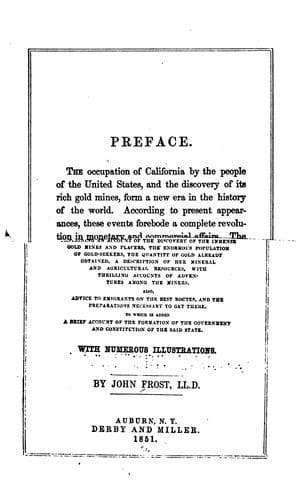
History of the State of California: From the Period of the Conquest by Spain to Her Occupation by the United States of AmericaFrost, John
History
History of the State of California: From the Period of the Conquest by Spain to Her Occupation by the United States of America
Frost, John
California -- Gold discoveries; California -- History
From the Pacific Spring, the trail passes over an arid, undulating
plain, in a west-by-north course, for about twenty-eight miles, when
the "Little Sandy" River, a branch of the Green or Colorado River,
presents itself, and furnishes the first water after leaving Pacific
Spring. From the Little Sandy River, the trail passes over a plain of
white sand or clay, and within twelve miles reaches the Big Sandy
River, and passes along it for about eighteen miles, and then strikes
off and crosses the Green River, or Colorado of the West. This river
is shallow and only about seventy yards broad. The trail then
continues down the Green River a short distance, and then, making a
right angle, ascends the bluffs bordering the valley of the stream, in
nearly a west course. The country then becomes still more broken and
barren, and the trail ascends gradually to the summit of a ridge, from
which it descends to the banks of the Black Fork, a tributary of the
Green River. This Black Fork is crossed several times upon the route,
but is not more than sixty yards wide and is very shallow. The trail
leaves it to cut off the bends and then returns to it. The scenery
along this part of the route is interesting, but the soil is
frightfully sterile. Diverging from the stream the trail passes over a
barren plain with no vegetation upon it except the wild sage, so
common even in the most sterile country, and then passes through a
bottom of grass, offering a good place for an encampment.
Near this place is Fort Bridger, a small trading-post established by a
Mr. Bridger. The buildings are two or three rudely constructed log
cabins, and they are situated in a handsome fertile bottom, on the
banks of a small stream. This fort is about eleven hundred miles from
Independence, Missouri. From Fort Bridger, many parties anxious to
explore the country, take the route by way of the south end of the
great Salt Lake. But the scarcity of water and the other difficulties
encountered in crossing the sterile plains and the great Salt Desert
should be sufficient to deter emigrants with families from taking that
direction. Oxen could not travel fast enough from one watering-place
to another, and must necessarily perish from thirst. Besides, the
route is but poorly defined, and may be wandered from very easily.
Public-domain text, read in full here on John Shaqi.
Reviews
Reviews
No reviews yet
Be the first to share your thoughts on this work.
Elsewhere in the archive
Join the Discussion
Join the discussion
Sign in to leave a comment or review.
Sign InorCreate an account