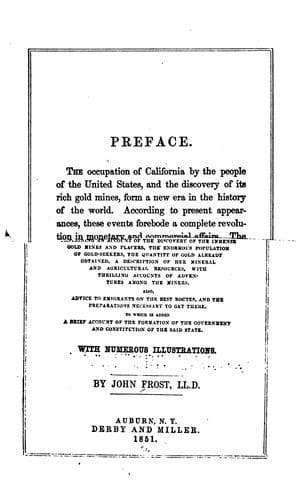
History of the State of California: From the Period of the Conquest by Spain to Her Occupation by the United States of AmericaFrost, John
History
History of the State of California: From the Period of the Conquest by Spain to Her Occupation by the United States of America
Frost, John
California -- Gold discoveries; California -- History
landmark among the mountains, called Independence Rock. It is an
isolated elevation, composed of masses of rock, about one hundred feet
in height, and a mile in circumference, standing near the northern
bend of the Sweetwater River, and between the ranges of mountains
which border the valley of that stream.
The trail proceeds up the Sweetwater River, and passes a remarkable
fissure in the Rocky Mountain wall, which is called the Devil's Gate.
The fissure is about thirty feet in breadth, and the perpendicular
walls on each side of the channel of the stream which flows through
it, are nearly three hundred feet high. The trail leaves the river
about twelve miles from where it first strikes it, and then returns to
it after traversing about sixteen miles. It again diverges from the
river and crosses a broken and arid plain, which presents but few
signs of vegetation. Passing through a gap between two ranges of
granite mountains, the first view of the Wind River Mountains is
obtained. The trail then proceeds through a narrow valley several
miles in length, the surface of which is white with an alkaline
efflorescence, and then returns to the Sweetwater River. Continuing up
the valley of the Sweetwater, occasionally leaving the bank of the
stream and passing over the rolling and barren tablelands, it crosses
two small creeks which present good places for encampment. Several
miles farther on, the trail crosses the Sweetwater River, and then
leaves it finally, making a gradual ascent to the South Pass of the
Rocky Mountains, or the dividing ridge which separate the waters of
the Atlantic and Pacific.
After the summit of the ridge is reached, the trail passes two or
three miles over a level surface, and then descends to the spring,
well known to emigrants as the "Pacific Spring." The water from this
spring is emptied into the Colorado River of the West, which river
empties into the Gulf of California. This Pacific Spring is two miles
west of the South Pass, and nine hundred and eighty-three miles from
Independence, Missouri.
Public-domain text, read in full here on John Shaqi.
Reviews
Reviews
No reviews yet
Be the first to share your thoughts on this work.
Elsewhere in the archive
Join the Discussion
Join the discussion
Sign in to leave a comment or review.
Sign InorCreate an account