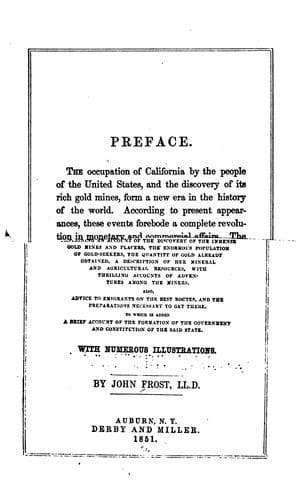
History of the State of California: From the Period of the Conquest by Spain to Her Occupation by the United States of AmericaFrost, John
History
History of the State of California: From the Period of the Conquest by Spain to Her Occupation by the United States of America
Frost, John
California -- Gold discoveries; California -- History
Things went on quietly in California until 1842. In that year,
Commodore Jones, while cruising in the Pacific, received information
which led him to believe that Mexico had declared war against the
United States. He determined to strike a blow at the supposed enemy,
and, accordingly, he appeared before Monterey, on the 19th of October,
1842, with the frigate United States and the sloop-of-war Cyane. He
demanded the surrender of all the castles, posts, and military places,
on penalty, if refused, of the visitation of the horrors of war. The
people were astonished. A council decided that no defence could be
made, and every thing was surrendered at once to the unexpected
Americans. The flag of the United States was hoisted, and the
commodore issued a proclamation to the Californians, inviting them to
submit to the government of the United States, which would protect
them in the exercise of their rights. The proclamation was scarcely
issued, before the commodore became aware of the peaceable relations
existing between the United States and Mexico, and he accordingly
restored the possession of Monterey to the authorities, and retired
with his forces to his ships, just twenty-four hours after the
surrender. This affair irritated the inhabitants considerably, and,
no doubt, tended to increase the ill-feeling before existing between
Mexico and the people of the United States.
CHAPTER V.
FROM THE COMMENCEMENT OF THE WAR TILL ITS CLOSE.
War was declared by Mexico against the United States, in May, 1846.
The same month, orders were transmitted to Commodore Sloat, commanding
the Pacific squadron, instructing him to protect the interests of the
citizens of the United States near his station, and to employ his
forces to the best advantage in operations directed against the
Mexican territory on the Pacific. The fleet under Commodore Sloat was
the largest the Americans ever sent to that quarter, and the men were
anxious to commence active operations. Soon after receiving his first
orders, the commodore was again instructed to take and keep possession
of Upper California; or, at least, of the principal ports.
On the 8th of June, Commodore Sloat left Mazatlan, in the flag-ship
Savannah, and on the 2d of July, reached Monterey, in Upper
California. There he found the Cyane and Levant, and learned that the
Portsmouth was at San Francisco, as previously arranged. On the
morning of the 7th, Captain Mervine was sent to demand the surrender
of Monterey. The Mexican commandant replied that he was not authorized
to surrender the place, but referred Commodore Sloat to the
commanding-general of California. A force of two hundred and fifty
marines and seamen was immediately landed, under Captain Mervine, and
they marched to the custom-house. There they hoisted the American flag
amid cheers and a salute of twenty-one guns. The proclamation of
Commodore Sloat was then read and posted about the town.
Public-domain text, read in full here on John Shaqi.
Reviews
Reviews
No reviews yet
Be the first to share your thoughts on this work.
Join the Discussion
Join the discussion
Sign in to leave a comment or review.
Sign InorCreate an account