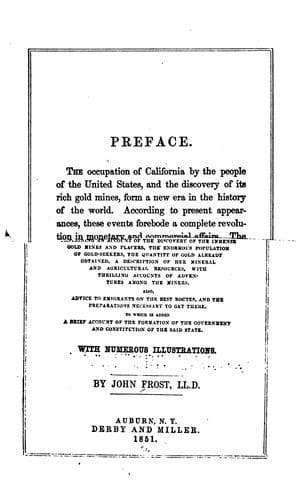
History of the State of California: From the Period of the Conquest by Spain to Her Occupation by the United States of AmericaFrost, John
History
History of the State of California: From the Period of the Conquest by Spain to Her Occupation by the United States of America
Frost, John
California -- Gold discoveries; California -- History
When much smaller and still rounded, they are called _gold dust_, and
when flattened, _scales_ or _spangles_. In nature, and when seen in
veins of quartz, gold often occurs _foliated_, or in leafy expansions
of extreme thinness, or in branchy (_dendritic_) forms, probably made
up of minute crystals. It is in the form of very minute grains that
the metal is generally disseminated through rocks and auriferous ores
of various metals, and these are reduced according to circumstances
in methods that will be alluded to in a future chapter. In pepitas and
small grains it is carried down by streams and deposited in their
beds, the pepitas being usually most abundant where there is reason to
suppose considerable disintegration of the surface, and where the
action of denuding causes to a great extent is evident. The coast of
Africa and the rivers of Europe are examples of the former case, while
the Siberian deposits and those of California would appear to belong
to the latter.
The following are examples of the constituent parts of various
specimens of gold obtained from different gold districts, and will
form a useful guide for comparison.
_Table showing the Composition of Native Gold.[19]_
------------------------------------------+-------+-------+-------+------
Locality. | Gold. |Silver.|Copper.| Iron.
------------------------------------------+-------+-------+-------+------
Auriferous sand of Schabrowski, near | | | |
Katherinenburg, Siberia (G. Rose) | 98·76 | 0·16 | 0·35 | 0·06
Boruschka, near Nijny-Tagilsk, Siberia | | | |
(Rose) | 94·41 | 5·23 | 0·39 | 0·04
Brazil (Darcet) | 94·00 | 6·85 | |
Beresovsk, Siberia (Rose) | 93·78 | 5·94 | 0·08 |
Sand near Miask, Siberia (Rose) | 92·47 | 7·27 | 0·06 | 0·08
Bogota (Boussingault) | 92·00 | 8·00 | |
Washings near Miask, Siberia (Rose) | 89·35 | 10·65 | |
Gold of Senegal (Darcet) | 86·97 | 10·53 | |
Auriferous sand, Nijny-Tagilsk, Siberia | | | |
(Rose) | 83·85 | 16·15 | |
Trinidad gold, (Boussingault) | 82·40 | 17·60 | |
Transylvanian gold (Ditto) | 64·52 | 35·48 | |
Mine of Sinarowski in the Altai (Rose) | 60·08 | 38·38 | 0·33 |
------------------------------------------+-------+-------+-------+------
The gold from California, according to the assay of Mr. Warwick of New
York, yields 89·58 per cent, pure gold, and is therefore, about equal
to that obtained from the washings of Miask (the richest district in
Western Siberia, and that producing the largest pepitas,) and
superior, as the assayer remarks, to the gold dust from Senegal.
Public-domain text, read in full here on John Shaqi.
Reviews
Reviews
No reviews yet
Be the first to share your thoughts on this work.
Elsewhere in the archive
Join the Discussion
Join the discussion
Sign in to leave a comment or review.
Sign InorCreate an account