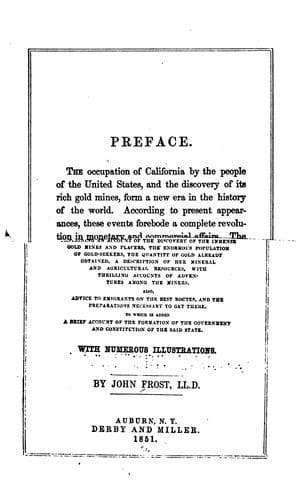
History of the State of California: From the Period of the Conquest by Spain to Her Occupation by the United States of AmericaFrost, John
History
History of the State of California: From the Period of the Conquest by Spain to Her Occupation by the United States of America
Frost, John
California -- Gold discoveries; California -- History
There is a remarkable mixture of native gold with silver occasionally
found in Siberia, and known under the name of _electrum_. Its color is
pale brass-yellow, passing into silver-white. It occurs in small
plates and imperfect cubes, and possesses many of the characters of
gold, but it consists only of 64 per cent. of that metal, and 36 per
cent. silver. It is at once known by its low specific gravity, which
does not exceed 12.
Other mixtures of gold are (1) a _rhodium-gold_ found in Mexico, and
containing 34 to 43 per cent. of rhodium, having a specific gravity of
15½-16·8, and a clear, dirty yellow color; and (2) a _palladium-gold_
(containing 9·85 per cent. palladium, and 4·17 per cent. silver) found
in Brazil and elsewhere in South America, in small crystalline grains
of pale yellow color. The auriferous ores of tellurium, including
silver, have hitherto only been found in Transylvania. Their color is
steel-gray, and they tarnish on exposure. The variety called
graphic-gold, or graphic tellurium, consists of about 60 per cent. of
tellurium, 30 per cent. gold, and 10 per cent. silver, and is worked
chiefly as an ore of gold. Another variety, "yellow gold glance,"
yields somewhat less tellurium, gold and silver, and as much as 20 per
cent. of lead.
Having now explained at some length the more manifest characteristics
of gold, namely, its color, hardness, and specific gravity, it is
necessary, before explaining the mode of separating it from associated
minerals, that we should here give some account of the behavior of
this metal under the blowpipe, and when exposed to simple chemical
tests. The assay of gold and its accurate analysis, we postpone for
the present.
The method of blowpipe analysis, although exceedingly useful, is not
absolutely necessary in the case of gold, because of the many readier
ways of determining the metal, but it seems advisable to state the
appearances presented. All the varieties are readily fusible into a
globule, which when the gold is pure, is unaltered by the continuance
of the heat. In this respect it differs entirely from iron and copper
pyrites, which, on being exposed to the flame, give off sulphur fumes
and undergo considerable change. In the case of gold containing other
metals, these, with the exception of silver; may generally be got rid
of by continuing the heat in the exterior flame with the addition of a
little nitre. Before the oxy-hydrogen blowpipe, the metal is
volatilized in the form of a purple oxide.
Public-domain text, read in full here on John Shaqi.
Reviews
Reviews
No reviews yet
Be the first to share your thoughts on this work.
Elsewhere in the archive
Join the Discussion
Join the discussion
Sign in to leave a comment or review.
Sign InorCreate an account