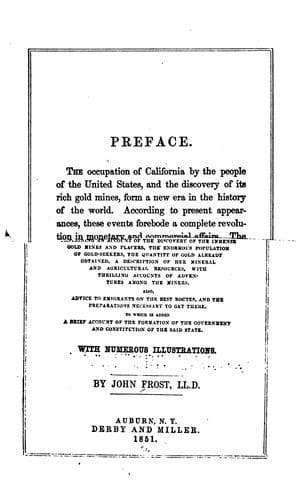
History of the State of California: From the Period of the Conquest by Spain to Her Occupation by the United States of AmericaFrost, John
History
History of the State of California: From the Period of the Conquest by Spain to Her Occupation by the United States of America
Frost, John
California -- Gold discoveries; California -- History
The great body of the emigrants continue to take the old route, which
we have elsewhere described, and find that it is the safest and
shortest of the land routes. Judging from the statements of the number
of emigrants who have passed Fort Laramie this season, we should say,
that the route could scarcely be called a wilderness, when it is
impossible to travel thirty miles without meeting with parties and
families of whites. Part of this tide of emigration will flow to
Oregon, no doubt, on account of the fertile lands to be there
obtained; but the golden land will get the bulk of it.
In a recent tour through the region bordering on Moqueleme River, in
California, a couple of gentlemen from Stockton, discovered a cave or
grotto of great extent. They found that it contained large quantities
of stalactite, and saw evidences of gold. The Indians who accompanied
the gentlemen were horror stricken at their audacity, when they
entered a cave which tradition said no man returned from alive. The
skeleton of a human being was found at some distance from the opening.
An event has occurred which will no doubt exercise a great influence
on California affairs. This is the discovery of the existence of
abundance of gold in Oregon territory. The discovery created great
excitement through the various cities and towns of Oregon, and the
northern towns of California. That which is exhibited, shows an
entirely different character to any of that dug in the mines of
California. It contains large quantities of platina, and is said to be
of a richer character. The mines just discovered are situated about
two hundred miles from Oregon City. The consequences of this discovery
may be easily apprehended. Oregon will secure a larger share of the
emigration from the Atlantic States than she had before, and her
progress will be rapid, for her soil and climate render the country an
attractive place of residence. But will the progress of California be
less rapid in consequence of this? We think not. The united
attractions of the two territories will operate for the benefit of
both, and only tend to increase the quantity of emigration.
FOOTNOTE:
[20] The _Alta Californian_, of the 1st of May, 1850, furnishes us
with an interesting account of the origin and meaning of the names of
places in the new State. We have elsewhere alluded to the name
California, as being derived from _caliente_ and _fornalla_, two
Spanish words, together signifying _hot furnace_.
_Pueblo de los Angeles--City of the Angels._ So named from the
fertility of the soil, the geniality of the climate, &c.
San Diego, Santa Barbara, San Luis Obispo, Santa Clara, Santa Cruz,
San Francisco, were all originally Catholic missionary stations and
were so named by the priests.
_Monterey_ signifies literally king of forests, and was so called in
honor of Count Monterey, as well as from the neighboring forest of
massive pines and other trees.
Public-domain text, read in full here on John Shaqi.
Reviews
Reviews
No reviews yet
Be the first to share your thoughts on this work.
Elsewhere in the archive
Join the Discussion
Join the discussion
Sign in to leave a comment or review.
Sign InorCreate an account