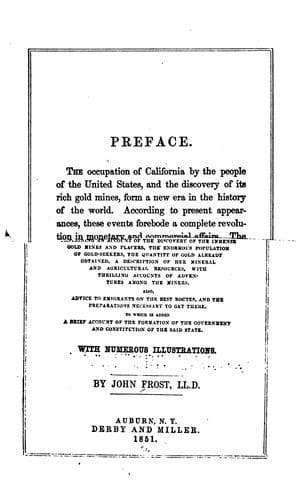
History of the State of California: From the Period of the Conquest by Spain to Her Occupation by the United States of AmericaFrost, John
History
History of the State of California: From the Period of the Conquest by Spain to Her Occupation by the United States of America
Frost, John
California -- Gold discoveries; California -- History
A letter dated Nevada, Oct. 24, says that the continued dry weather
has given unusual opportunities and facilities to miners now working
in the river channels. At the best these operations are very
precarious in their nature--necessarily attended with a vast outlay,
and frequently, where the most sanguine hopes were entertained, the
results have been most unfortunate. The time for working in the rivers
is usually confined to a very limited period, the water being seldom
or never sufficiently low to work to advantage earlier than September;
it follows, therefore, that every additional week of dry weather is of
the utmost value to such as are thus engaged. Luckily for them, the
present dry season has been unusually protracted, consequent upon
which, the rivers are at an exceedingly low stage, and the success of
the miner proportionate to this advantage. On the other hand, those
interested in ravine and hill mining (by far the greater proportion of
the miners,) are anxiously awaiting the wet season for a supply of
water--without which, all their labor is fruitless.
The Bear River and Auburn Water Company's canal is so far completed as
to be available to the miners by the first rains, notwithstanding the
great expense and time attending its construction, arising from a want
of experience, and so far beyond the calculations of its projectors.
This work traverses an extensive and rich mining country, totally
dependent upon the canal for water, which cannot be exhausted for many
years.
The discovery of a continuation of the celebrated Coyote lead, in
Nevada, from which so many millions of the precious metals were
extracted in '50 and '51, is now established beyond a doubt. As yet it
is not developed to any great extent, but enough, however, to give
employment to a goodly number of miners. The character of the lead
continues to be similar to the old mines, in appearance and
productiveness. A few weeks' further investigation of the locality
will no doubt give a new impetus to mining operations here, which have
latterly been somewhat stagnant.
The Sacramento Journal says:--We have been shown a lot of the gold
taken out of the Mokelumne run, valued at $2,500, which was superior
to any thing we ever examined before. The pieces of glittering ore
were of sizes varying from a cucumber seed up to a pumpkin seed, and
all in that flat, oval shape so peculiarly characteristic of Mokelumne
gold. It was sent down from the store of D. L. Angier, in Calaveras
county, and we are informed that the same company of six men that
disposed of it, have taken out of the claim $36,000 of the same kind
of specimens.
Gold has been found in considerable quantities in the mountains back
of San Buenaventura. The existence of the gold was made known by the
Indians to some white men, who, on visiting the spot indicated, were
rewarded with six ounces of the precious metal. The prospect is said
to be good.
Public-domain text, read in full here on John Shaqi.
Reviews
Reviews
No reviews yet
Be the first to share your thoughts on this work.
Elsewhere in the archive
Join the Discussion
Join the discussion
Sign in to leave a comment or review.
Sign InorCreate an account