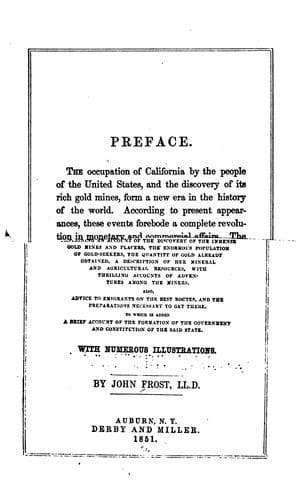
History of the State of California: From the Period of the Conquest by Spain to Her Occupation by the United States of AmericaFrost, John
History
History of the State of California: From the Period of the Conquest by Spain to Her Occupation by the United States of America
Frost, John
California -- Gold discoveries; California -- History
Three quartz mills have recently commenced operations in Scott valley.
We have not received any definite information as to what these mills
have accomplished, but are informed that one of them is producing gold
in great abundance.
The Columbia Mining Company took out 12 lbs. of gold in one day, and 8
lbs. at night--making in all 20 lbs. The same gentleman informs us
that miners generally in that vicinity are doing remarkably well.
New diggings have been discovered near the American ranche. Those
working there are getting well paid, in coarse, heavy gold. They are
making from $12 to $20 per day to the man. The diggings are ravine
diggings, and can be worked all winter.
A convention of the quartz miners of Nevada county was to have been
held at Nevada on the 13th of November, to adopt measures having for
their purpose more unity of operation and greater security of labor
and capital.
The San Francisco papers of Jan. 1, 1853, contain most interesting
intelligence of the state of the gold region. The following is the
most important:--
The present winter is conceded to be the most severe experienced in
this country since it has been populated by Americans. During the last
fortnight it has been raining and snowing continually in the
mountains and valleys, and we are daily in the receipt of accounts of
disasters and suffering in all parts of the state. The waters have
been unusually high, and communication through the mining regions
almost entirely cut off, either by snow or overflowed streams. The
rivers have been swelled to such an extent as to inundate all the low
lands, causing immense damage, destroying stock and agricultural
products.
The whole country between Tehama and Sacramento city was entirely
under water, whilst Marysville was partly inundated, and though
Sacramento city was well protected by a levee, the lower portions were
submerged. The waters at the present time have subsided, although the
rains still continue. On the mountain streams, the loss of mining
implements has been great, and all work for the present is suspended.
Bridges have been swept away, and ferries destroyed, and some few
lives lost. The southern portion of the mining district has suffered
equally with the northern. Stockton has been inundated partially, and
property to a considerable amount destroyed. The bridges on the
Calaveras, Stanislaus, and other streams have been swept away, and
communication with the mining towns for a while suspended. The flood
has been universal, and the waters higher than in the memorable winter
of 1849.
Public-domain text, read in full here on John Shaqi.
Reviews
Reviews
No reviews yet
Be the first to share your thoughts on this work.
Elsewhere in the archive
Join the Discussion
Join the discussion
Sign in to leave a comment or review.
Sign InorCreate an account